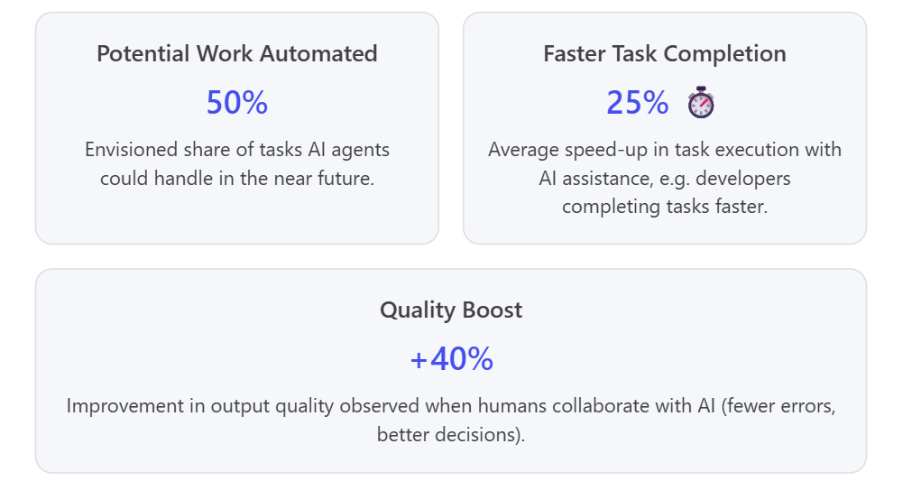
Imagine if 50% of the work in your organization could be performed by AI agents. This provocative question 1 captures the promise of Digital Agents (also known as digital workers or AI agents) in the modern enterprise. These intelligent software assistants are transforming how we develop software and how we run business operations. Forward-looking organizations envision a future where human employees work hand-in-hand with AI, delegating routine tasks to digital agents and focusing human talent on higher-value activities 2 3. The result is not about replacing people, but augmenting the workforce – boosting productivity, efficiency, and innovation across the board.
This blog explores two major arenas of impact for digital agents:
- Digital Agents in the Software Development Lifecycle (SDLC) – how AI agents can automate and optimize phases from requirements to deployment, revolutionizing IT workflows.
- Digital Agents for Business Problems – how AI agents can tackle tasks in business functions like HR, finance, legal, customer service, and procurement, driving operational excellence and a new human+AI working model.
We’ll dive into examples of agent-enabled workflows, highlight productivity gains and ROI, and discuss how human + AI collaboration is reshaping roles in both IT and business contexts. Let’s unlock the digital workforce strategy.
Digital Agents in the Software Development Lifecycle (SDLC)
Software development is a complex, multi-stage process—spanning requirements gathering, design, coding, testing, deployment, and operations. Digital agents are now being deployed at each of these stages to automate tedious work, act as intelligent assistants, and accelerate the Software Development Lifecycle. The goal: create dramatic development efficiency gains 4 5 while maintaining high quality. In fact, by enforcing standards and providing real-time insights, AI agents can help achieve a “dramatic reduction in technical debt and rework, increasing development velocity and quality.” 6Some key ways AI-powered agents enhance the SDLC include:
- Requirements Gathering & Backlog Creation: Instead of traditional manual interviews and note-taking, a Requirements Capture Agent can engage with stakeholders in natural language to capture needs and translate them into user stories. Neudesic’s own Requirements Capture Accelerator uses conversational scenarios to gather user-specific requirements and draft them as structured user stories 7. Following that, a Backlog Population Agent can automatically populate the project backlog (e.g. in Azure DevOps or Jira) with those user stories and tasks. In practice, an accelerator does exactly this – taking the captured requirements and generating work items, ensuring nothing is missed 8. This agentic workflow saves project managers and business analysts countless hours and ensures the development team always has an up-to-date, well-defined backlog.
- Code Generation & Conversion: One of the most exciting developments is using AI to actually write or refactor code. Modern code assistants (like GitHub Copilot or custom AI models) can generate code snippets or even entire modules from specifications. For example, Neudesic has a Code Conversion Accelerator that ingests legacy code and helps convert it into modern, decoupled architectures 9. This kind of digital worker can analyze an old monolithic application and produce new code following current best practices, handling in minutes what could take developers weeks when done manually. Beyond conversion, generative AI agents can produce boilerplate code, suggest improvements, and ensure coding standards are followed consistently. Developers thus spend more time on innovative or complex logic, while the AI handles routine coding tasks. Companies are finding that with these agent assistants, teams can deliver features faster and with fewer defects – one internal study noted that developers with AI support finished 12% more tasks on average 10.
- Intelligent Testing & QA: Testing is a phase ripe for AI automation. Digital QA agents can generate test cases, run them, and even fix simple bugs. A great example is the CI/CD Accelerator, an AI agent that acts in the continuous integration pipeline to review code before it’s released 11. This agent analyzes new code “as a human would” – catching potential bugs, security vulnerabilities, or deviations from design – and validates that the software meets acceptance criteria 12. By acting as an tireless code reviewer, the agent helps prevent regressions and ensures build quality. Similarly, an autonomous QA Tester agent can execute application tests (including edge cases) far faster than a human, flagging issues immediately. These AI-driven tests improve coverage and reliability of software. The net effect is a faster QA cycle and higher quality output.
- Deployment & DevOps Automation: In the deployment phase, digital agents integrate with DevOps tools to streamline releases. For instance, an AI agent can monitor a continuous deployment pipeline, automatically promote builds that meet quality gates, or roll back ones that don’t. The CI/CD agent mentioned above contributes here, and a Release Management Agent can coordinate deployments across environments. The benefits are error-free, compliant releases delivered faster 13. Furthermore, in cloud infrastructure, agents can manage environment setup or scaling – essentially acting as “Ops bots” provisioning resources via scripts. This tight integration of AI with DevOps means teams achieve rapid, reliable releases with minimal manual effort.
- Operations Monitoring & Optimization: After software is live, AI agents continue to add value in operations. An Operations Analysis Agent can continuously watch running applications and infrastructure for anomalies or improvement opportunities 14. For example, Neudesic’s Operations Analysis Accelerator engages with the operational environment to optimize cloud costs and check system health of deployed code 15. These agents might analyze logs and performance metrics to predict issues before they happen (like forecasting a potential outage or spotting a memory leak pattern) and either alert humans or even resolve it autonomously. They can also handle routine maintenance tasks: imagine an agent that automatically clears temp files, rotates logs, or even applies minor patches during off-hours. By reducing support tickets and downtime (as one slide put it, to “drive IT tickets down” 16), such operational agents improve system reliability and free up IT staff to focus on strategic improvements rather than firefighting.
Integration with DevOps & Tools: Importantly, digital SDLC agents don’t work in isolation – they plug into existing toolchains. They interface with project management tools (Azure Boards, Jira), code repos (GitHub, GitLab), CI/CD systems (Jenkins, Azure Pipelines), testing frameworks, and cloud management consoles 17 18. This integration means the AI can act on real project data and trigger real actions. For instance, an AI planning agent might scan an entire repository’s documentation and past backlogs to learn context 19, then help a team automatically generate a new set of user stories and test cases for a feature 20 21. Developers and ops engineers can converse with these agents (via chat or natural language interfaces) to get things done quickly. The result is a more streamlined, collaborative DevOps workflow, where humans define goals and review outcomes, and AI agents do the heavy lifting in between. One internal approach calls this Agentic Software Engineering, where AI assists in every stage – enforcing standards across stages and maintaining traceability from requirements to code to documentation in real-time 22 23.
- ROI and Efficiency Gains: The business case for SDLC digital agents is compelling. By automating away drudgery and speeding up cycle times, organizations see faster delivery of software and lower development costs per feature. Quality improvements mean less rework and fewer production issues, which translates to savings. In one instance, combining AI “grounded” in a company’s coding standards with spec-driven development yielded unified standards and real-time traceability, and significantly cut down on rework 24. It’s not unusual to achieve several-fold productivity improvements in certain tasks – for example, code analysis that might take a human 2 days can be done by an AI in 2 hours (a ~10x speedup). Even more broadly, tech industry research suggests top teams leveraging AI have seen roughly 25% faster completion of tasks and 40% improvement in code quality on average 25. All of this directly boosts the IT organization’s Return on Investment (ROI). Teams can deliver more value in the same time frame, often with the same or fewer resources. Moreover, developers are happier (focusing on creative work instead of grunt work) and the IT organization becomes more agile in responding to business needs. In short, digital agents in the SDLC are accelerating software delivery while driving down costs and elevating quality – a powerful dual benefit.
To summarize how digital agents map to each SDLC stage, here is a breakdown of AI agent applications across the software lifecycle:
| SDLC Stage | Example Digital Agent | Role & Benefits |
| Requirements Analysis | Requirements Capture Agent | Conversationally gathers user needs and converts them into structured requirements/user stories5. Helps ensure clarity and saves BA time. |
| Backlog & Planning | Backlog Population Agent | Auto-generates and updates backlog items (features, tasks, test cases) from requirements5 for streamlined sprint planning. |
| Development (Coding) | Code Generation/Conversion Agent | Writes code or refactors legacy code into modern frameworks5. Accelerates development and modernizes codebases while enforcing standards. |
| Testing & QA | Test Generation & CI/CD Agent | Creates test cases and performs code reviews in CI pipeline5. Detects bugs or security issues early, improving quality and reducing manual QA effort. |
| Deployment | Release Management Agent | Automates build deployments and environment setup. Ensures compliant, error-free releases (e.g. verifying all checks pass) and speeds up release cycles4. |
| Operations & Monitoring | Operations Analysis Agent | Monitors runtime systems, optimizes performance and cloud costs, and handles routine ops tasks5. Reduces outages and support tickets (“Drive IT tickets down”1) while keeping systems efficient. |
Each of these agent types contributes to a more efficient and intelligent software factory. By leveraging them, IT teams can handle greater workloads (some envision 5–10x output per developer in certain activities) and scale software delivery without linear headcount growth. In the “AI era” of development, the scaling factor of work relative to purely manual effort is tremendous – ultimately, autonomous coding agents could magnify output up to 25–100x in certain scenarios 26. While full autonomy is still on the horizon, even today’s human-in-the-loop agents have ushered in a new paradigm: developers co-creating with AI for exponential gains 27.
Finally, it’s worth noting that adopting digital workers in SDLC may require process adjustments and upskilling. Teams must learn to trust agent recommendations, validate their outputs, and continuously improve the AI’s knowledge (for example, feeding in new design patterns or business domain rules). Many organizations establish AI-assisted development guidelines and train their staff on effective use of these tools. The payoff is well worth it – those who embrace AI in development early are seeing shorter development cycles and higher-quality software, which is a competitive advantage in fast-moving markets.
Digital Agents for Business Problems
Beyond IT departments, digital agents are driving transformation across core business functions. In every domain – from human resources to finance to customer service – there are countless repetitive or knowledge-driven tasks that AI agents can perform faster, cheaper, and often more accurately. The Digital Worker Strategy identifies “Your IT Organization and The Business” as two parallel focus areas 28. In other words, while software development teams reap the rewards of AI automation, so do departments like HR, finance, legal, operations, and others. The ultimate vision is that every area of the business can scale with AI 29, achieving new levels of productivity, operational efficiency, and customer value.
Let’s explore how digital agents are applied to various business problems and processes, with examples:
- Human Resources (HR): HR organizations are using AI agents to improve employee service and streamline HR processes. For instance, an HR Assistant Agent can answer employee questions 24/7 (about policies, benefits, PTO, etc.), schedule interviews, and even handle onboarding paperwork. This improves “HR availability” to the workforce 30 – employees get immediate answers and support, without waiting for HR staff, leading to better satisfaction. Meanwhile, HR staff are freed from answering repetitive queries and can focus on strategic initiatives like talent development. Digital agents are also used for resume screening, training FAQ bots, and monitoring employee sentiment. The result is an HR function that’s more responsive and efficient, with agents taking on administrative load and ensuring no query falls through the cracks.
- Finance (Accounting & Compliance): In finance and accounting, digital workers excel at tasks involving data entry, reconciliation, and compliance checks. A common example is an Accounts Payable Agent that can receive invoices (even read them via OCR), match them to purchase orders, and process payments – essentially automating the invoice approval workflow. This yields AR/AP (Accounts Receivable/Payable) efficiency gains 31: invoices get processed faster, with fewer errors and less manual labor. Another example is a Financial Compliance Agent that continuously audits transactions against compliance rules or flags anomalies. By doing so, it improves financial compliance and catches issues early 32 – something especially valuable in industries with heavy regulatory burdens. Banks and insurers, for instance, deploy AI agents to monitor transactions for fraud or to ensure regulatory filings are accurate. These agents can handle massive volumes of data far beyond human capacity, ensuring nothing is overlooked. The finance team can then trust that routine processing and initial compliance checking are handled, and they can focus on complex analysis and strategic financial planning.
- Legal: Legal departments and law firms are leveraging AI agents to research, draft, and review documents. An AI Contract Analyst, for example, can scan contracts and highlight key clauses, deviations, or risks – greatly speeding up contract review cycles. This addresses the need to “accelerate legal alignment” (ensuring business agreements meet legal standards quickly) 33. Another example: an AI Regulatory Research Agent can continuously track new laws or regulations and summarize what a company needs to do to comply (acting as a virtual legal researcher). In practice, the impact has been significant. In one case, a professional services firm built a digital agent to assist in RFP (Request for Proposal) responses and legal research. The results were impressive: they saw a 60% reduction in non-billable research time and about 2 hours saved per proposal response, enabling the team to turn around proposals in days instead of weeks 34. These metrics translate to huge cost savings (in that case, roughly $$ increase per customer 35).
- Procurement & Supply Chain: Supply chain and procurement processes involve repetitive tasks like order processing, inventory monitoring, and vendor communications. AI agents are proving invaluable here. A Procurement Agent might automatically reorder supplies when inventory is low, after checking multiple supplier catalogs for the best price – significantly speeding up the procurement cycle and ensuring the business never runs out of critical materials. In manufacturing or retail contexts, a Demand Planning Digital Worker can forecast demand using AI and adjust procurement orders and inventory levels accordingly. In fact, an AI Demand Planner and AI Inventory Planner were highlighted as digital workforce examples to optimize inventory relative to sales 36. These agents work together with human planners: the AI crunches numbers and suggests optimal stock levels or reorder points, while humans make final calls and handle supplier relationships. The benefits include inventory alignment to revenue (avoiding overstock or stockouts) 37 and freed-up time for supply chain managers. In one scenario, a retailer using AI for inventory saw a 20% improvement in inventory holding efficiency, translating to millions in savings 38. Procurement agents can also enforce compliance (buying only from approved vendors, etc.), which helps in reducing risk and ensuring policy adherence.
- Other Functions (Operations, Risk, etc.): Virtually every business function you can think of has potential for digital agent support. In operations and manufacturing, Predictive Maintenance Agents analyze sensor data from equipment to predict failures and schedule maintenance proactively 39. This reduces downtime and maintenance costs. In risk management, an AI Risk Analyst could continuously evaluate operational or market risks and alert management if thresholds are crossed, contributing to risk optimization in decisions 40. Even in domains like security & monitoring, AI agents patrol networks or camera feeds to detect anomalies (e.g., cybersecurity threats or physical security issues) much faster than human analysts could. For example, an agent might flag unusual login patterns that indicate a cyberattack in progress, allowing quick mitigation. There are also digital coworkers emerging in domains like procurement (auto-checking purchase orders), regulatory compliance (generating required reports), engineering (automating CAD tasks), and more.
Crucially, the introduction of digital agents in business processes is changing how jobs are structured. Rather than having one person handle a process end-to-end, we break down the process into tasks and assign some of those tasks to AI agents. The strategy emphasizes understanding a job as a set of tasks with outcomes, decomposing those tasks into sub-tasks, and then building digital workers that can reliably finish the sub-tasks 41. This task decomposition is key: by analyzing workflows, companies identify which pieces can be automated (and to what degree) and which pieces require human judgment or creativity. The AI does the well-defined, repeatable parts, whereas humans handle exceptions, make complex decisions, and provide oversight. Over time, this will even change job descriptions. As one internal analysis put it, the “task groupings for AI and human will alter the composition of jobs” going forward 42. We’re already seeing new roles like “AI supervisor” or “digital workforce manager” – people who specialize in managing fleets of AI agents, much like a manager supervises human employees.
This human–AI teaming is at the heart of the human + AI collaboration model. Far from making human workers obsolete, digital agents often act as teammates or copilots. The presentation calls it “Digital Labor becomes your teammate and first point of call to get things done.” 43 People will increasingly delegate initial work to an AI agent, then refine or approve the results. For example, an HR specialist might ask an AI agent to draft an update to the employee handbook; the agent produces a solid first draft by pulling from company policies and legal requirements, and then the human polishes the language and nuances. Workers in all functions need to adapt to this new mode of working – the era is “not just about reskilling; it’s about retooling and delegating in a way we haven’t before.” 44 Successful organizations are training their staff not just in new technical skills, but in how to effectively leverage AI tools and digital workers in their daily jobs. Interestingly, 87% of executives expect jobs to be augmented rather than replaced by generative AI, underscoring that the future workforce is a blended one 45.
Let’s consider a few concrete examples of digital agents in business functions and their impacts:
| Business Function | Digital Agent Application | Impact & Benefits |
| Human Resources | Virtual HR Assistant – answers employee HR questions, schedules meetings, helps onboarding paperwork. | Always-on support for employees; reduces HR workload on FAQs, speeds up onboarding; improves employee satisfaction with quick responses1. |
| Finance & Accounting | AP Invoice Processing Agent – reads invoices, matches POs, initiates payments in ERP system. | Faster invoice cycle (days to minutes per invoice); fewer errors in data entry; improved AP efficiency and compliance checks (duplicate or fraudulent invoices flagged)1. |
| Legal | Contract Analysis Agent – reviews contracts, highlights risky clauses or missing terms against a checklist. | Cuts legal review time significantly (e.g., 60% faster)8; ensures no clause is overlooked; lawyers can focus on negotiation and complex issues instead of rote checks. |
| Customer Service | AI Customer Support Chatbot – handles Tier-1 queries and troubleshooting across web/chat channels. | Instant responses 24/7; deflects a large portion of calls from human agents; improves first-contact resolution and customer experience; human agents focus on high-value or escalated cases. |
| Procurement | Procurement Automation Agent – auto-reorders inventory when below threshold, solicits quotes from suppliers. | Ensures continuity of supply (no stockouts); saves procurement officers time on routine orders; often gets better pricing by quickly comparing options; yields procurement efficiency and cost savings. |
| Operations / Maintenance | Predictive Maintenance Agent – monitors equipment sensor data to predict failures and schedule maintenance. | Reduces unplanned downtime by scheduling fixes before breakdowns1; optimizes maintenance cycles (maintenance only when needed); extends equipment life and cuts maintenance costs. |
| Sales & Marketing | Sales Outreach Agent – automatically sends personalized follow-up emails to leads and schedules sales calls. | Increases lead engagement (no lead falls through); sales team spends time only on warm leads; ultimately drives higher conversion rates (sales acceleration)1. |
| Risk Management | Risk Monitoring Agent – continuously analyzes operational data and external news for emerging risks. | Early warning system for risks (e.g. supply chain disruptions, market changes); helps management respond proactively; improves risk mitigation and readiness (contributing to risk optimization)1. |
These examples scratch the surface – new digital agent use cases emerge almost daily. Importantly, deploying digital workers across the business leads to measurable improvements. We’ve already mentioned some: 60% time reduction here, 2x faster processing there. At a higher level, organizations pursuing a digital workforce strategy look for three big categories of impact: 1) Productivity and workforce effectiveness, 2) Operational efficiency, and 3) Direct value to customers 46. Productivity gains come from AI handling half the work, effectively doubling what the team can do with the same people 47 48. Efficiency gains mean processes cost less and run faster (for example, a finance process might handle 5x the transactions per person with AI help). Direct customer value arises when AI agents enable offerings that win or retain customers – for instance, faster service response or more personalized recommendations lead to happier customers and more sales. Indeed, one aim noted is a tangible increase in revenue or customer spend thanks to AI-enhanced services 49.
Achieving these benefits at scale does require careful planning and change management. Rolling out digital agents enterprise-wide isn’t just an IT project; it’s an organizational change. Many companies start with pilot projects in a few functions to prove value, then expand. It helps to have a strong governance and monitoring framework – often a “digital workforce platform” – to manage all the AI agents, track their performance, and ensure they comply with policies 50. Neudesic’s Workforce IQ solution, for example, provides a “single pane of glass” to manage and govern digital workers across the enterprise 51. This includes compliance dashboards and even an AI “HR department” for your virtual agents (handling their credentials, monitoring their outputs, applying kill-switches if needed) 52. Such platforms are becoming part of the new operating model required for a scaled digital workforce.
Equally important is the people side: training employees to work alongside AI, addressing concerns, and redesigning jobs thoughtfully. Change management is critical because, understandably, some employees may worry about job security or be resistant to new AI tools. Leadership must communicate that the strategy is about empowering employees, not eliminating them. In practice, many organizations find that once employees start using digital agents and realize how much time is freed up from drudgery, they become enthusiastic adopters. It’s often about getting over the initial learning curve and trust barrier. Offering reskilling opportunities (to move people into more analytical or creative roles that the AI cannot do) is part of a responsible approach. In the end, companies that combine technology deployment with workforce upskilling and clear communication tend to see the best results – they create a culture where human-AI collaboration is embraced, and every employee becomes adept at delegating tasks to their digital “colleagues.”
Embracing the Human + AI Future
The rise of digital agents in both SDLC and business functions signals a profound shift in how work gets done. We are effectively retooling our workforce, adding a digital workforce that works alongside the human workforce. Organizations that harness this will be able to scale operations without a commensurate rise in costs, achieve levels of speed and accuracy previously impossible, and redirect their human talent to innovation and problem-solving. As one internal report noted, 87% of executives believe jobs will be augmented rather than replaced by AI – meaning the dominant model is hybrid teams, not AI-only automation 53.
Already, top companies are reporting substantial ROI from their AI initiatives. AI-centric strategies can make teams nearly twice as effective and deliver significantly higher ROI on projects 54. And this is just the beginning. The “AI era” is often compared to past industrial revolutions in terms of impact. Just as electrification or computers transformed work in the 20th century, AI agents are transforming work in the 21st. Businesses must therefore innovate their processes and reimagine roles to fully capitalize on agentic capabilities.
To implement a digital worker strategy successfully, consider these steps: identify high-impact use cases, start with pilot agents, measure results, and iterate. Engage both IT and business stakeholders in these projects – it’s essential to collaborate so that solutions meet real needs. Also, invest in the right tools and platforms that allow you to develop, deploy, and monitor AI agents securely at scale.
Most importantly, cultivate a mindset across the company that views AI as an opportunity to increase capacity and creativity. Employees should be encouraged to ask: “Which parts of my job can I delegate to an AI agent?” and “How can I work smarter with AI support?”. When people start thinking that way, you unlock many small improvements that add up. One example is an internal drive at Neudesic where every employee is encouraged to delegate tasks to AI daily and share what worked, fostering a bottoms-up evolution of work culture 55 56.
In conclusion, Digital Agents are becoming invaluable teammates in both software development and business operations. They perform tasks at speed and scale, ensure consistency and compliance, and continuously learn and adapt. By structuring workflows as human+AI partnerships, companies can achieve breakthroughs in productivity and service quality. Those that lead in this transformation will see big gains in agility and competitiveness. The Digital Worker Strategy is about boldly embracing this change – envisioning a future where perhaps half of your organization’s work is handled by AI agents 57, and the sum of human and digital labor produces far more than either could alone 58. It’s a future where your digital workforce is as critical as your human workforce in executing your business strategy.
Organizations already on this journey are witnessing how roles transform: employees become orchestrators and innovators, while digital agents are the executors for many tasks. Together, they deliver outcomes that neither could achieve as effectively on their own. This synergy between people and AI – delegating and co-working in unprecedented ways – is unlocking new levels of performance. As you consider your own company’s evolution, ask yourself and your team: What could we achieve if we truly integrated digital agents into our work? The answer may well define the next leap in your organization’s success. Embrace the era of digital workers, and prepare to unleash a new wave of productivity and innovation across both IT and business functions. The tools are here, the use cases are clear – now is the time to put AI agents to work on your biggest challenges. Your future workforce will thank you for it, as will your bottom line.
 Nathan Lasnoski