What if 50% of the work in your organization could be performed by AI agents? This provocative idea captures the promise of Digital Workers (AI-driven software assistants) in the modern enterprise 1. It’s not about replacing people, but augmenting the workforce – offloading routine tasks to AI so human talent focuses on higher-value activities 2. Today, we stand at a pivotal moment: Microsoft’s new Azure AI Agent Framework is poised to turn that vision into reality by bringing together powerful tools (Semantic Kernel and AutoGen) into a unified platform. This framework provides the orchestration, simplicity, and modularity needed for companies to finally take their fleet of digital workers from experimental to critical mass.
In this post, we’ll explore how Azure’s Agent Framework combines the best of Semantic Kernel and AutoGen, what that means both technically and business-wise, and why it’s a big deal for any organization betting on AI agents. We’ll also look at some generic enterprise use cases – from document processing to customer support – to illustrate the transformative potential. So, buckle up, because this is going to be an exciting look at the future of work with AI (in true Nathan Lasnoski style).

The Rise of Digital Workers – And the Need for a Unified Framework
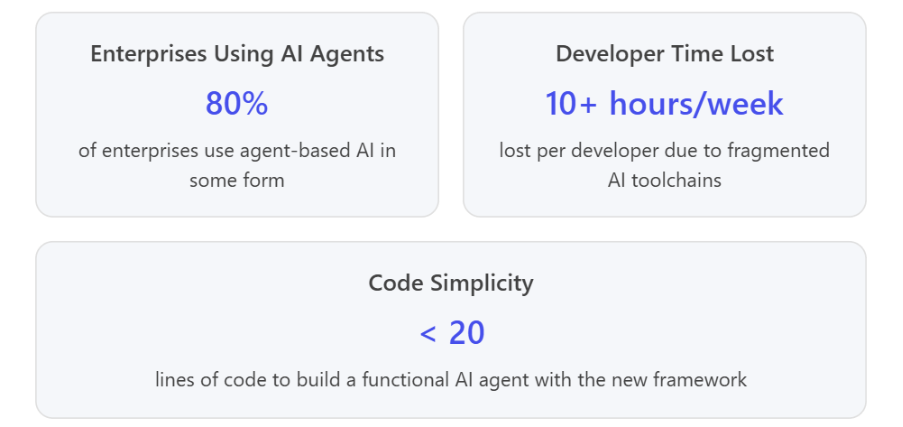
Digital workers (AI agents and copilots) have been creeping into the enterprise in recent years. In fact, eight in ten enterprises now use some form of agent-based AI, according to a recent PwC survey 3. These agents might be answering customer chats, triaging IT tickets, processing invoices, or helping plan projects. The interest is huge, but so is the complexity of managing them at scale. Many early adopters hacked together solutions with disparate tools – maybe using one toolkit for reliable production bots and another for experimental multi-agent demos. Developers ended up juggling fragmented tooling, and organizations worried if these agents would behave reliably and securely 4. In short, the momentum was there, but the friction was real.
Microsoft heard this loud and clear. Up to 50% of developers were losing 10+ hours per week due to inefficiencies from switching between AI frameworks and tools 5. This fragmentation slowed down the path from prototype to production. What was missing was a unified orchestration layer – something to bring all the capabilities under one roof, with enterprise-grade governance. Enter the Azure AI Agent Framework.
Published in public preview in October 2025, the Azure AI Agent Framework is an open-source SDK and runtime that simplifies the orchestration of multi-agent systems 6. It converges AutoGen, a cutting-edge Microsoft Research project, with the enterprise-ready Semantic Kernel foundations into one commercial-grade framework 7. In plainer terms: it fuses the best of both worlds (the innovative multi-agent techniques and the stable, enterprise-focused tooling) into a single platform. Microsoft’s goal here is to eliminate the either/or choice developers faced and provide a single clear path to build, orchestrate, and deploy sophisticated AI agents from initial prototype to enterprise-scale production.
Semantic Kernel + AutoGen = One Powerful Agent Framework
To appreciate the significance, let’s briefly recall what Semantic Kernel and AutoGen are, and why bringing them together is so powerful.
- Semantic Kernel (SK) – This was Microsoft’s open-source SDK geared for enterprise AI development. It provides the stable, production-ready foundation for AI orchestration, with support for integrating large language models into apps, managing prompts, memory, and connecting to enterprise systems (often via “skills” or plugins). SK prioritized reliability, security, and supportability, with version 1.0 focusing on non-breaking changes and even Microsoft support channels for enterprise adopters. In essence, SK was the enterprise-grade toolkit: think robust SDK, Azure integration, and a design that ensured your AI assistant wouldn’t break when you upgrade it.
- AutoGen – This was a more experimental framework emerging from Microsoft Research, aimed at advanced multi-agent orchestration. AutoGen made it easier to spin up multiple AI agents that could converse with each other, follow complex interaction patterns (like having a “manager” agent coordinating several “worker” agents), engage in recursive reasoning, or even debate to reach better answers 8. It was all about pushing the boundaries of what AI agents can do together. However, being fast-evolving, AutoGen was more of a research playground – great for innovation, but not originally built with long-term enterprise operations in mind.
Originally, these two tools lived separate lives. Developers had to choose: Do I want the stability and support of SK, or the cutting-edge features of AutoGen? Many of us felt the gap between experimental innovation and production readiness. The Azure AI Agent Framework bridges that gap by unifying the enterprise-ready foundations of Semantic Kernel with the innovative orchestration of AutoGen. Microsoft basically took the strongest capabilities of each and combined them into one SDK. The result is a framework that doesn’t force that trade-off anymore – you get the stable base and the fancy new tricks in one package.
To see how SK and AutoGen complement each other within the unified framework, here’s a quick comparison:
| Aspect | Semantic Kernel (Enterprise Foundation) | AutoGen (Research Orchestration) |
| Origin & Focus | Open-source SDK from Microsoft focused on enterprise stability and integration. Backed by Microsoft support (v1.0) for production use. | Open-source multi-agent framework from MSR emphasizing experimental features and AI-agent collaboration. Geared towards pushing new orchestration patterns. |
| Key Capabilities | Orchestration of single-agent workflows with plugins (“skills”) for tools/knowledge, prompt management, and memory. Excellent at hooking up LLMs to enterprise data/APIs in a reliable way\4\4. | Orchestration of multi-agent conversations and dynamic task delegation. Offers patterns like manager-worker agent teams, group discussions, self-refinement loops, etc., to tackle complex tasks via agent collaboration3. |
| Strengths | Production-ready: Stable APIs, versioning, and enterprise security/identity integration (fits well with Azure ecosystem). Ensures solutions are supportable long-term. Great for single-agent scenarios that need robust integration (e.g., a chatbot with plugins). | Innovative: Rapidly incorporates the latest research (e.g., new prompting strategies, cooperation schemes). Ideal for complex tasks where multiple specialized agents need to work in concert (e.g., an agent plans while another executes)3. |
| Limitations | Limited to one primary agent’s reasoning loop at a time; required more custom work to enable agents talking to each other. Could feel rigid when trying bleeding-edge ideas not yet officially supported. | Less emphasis on enterprise requirements initially – lacked built-in compliance, monitoring, or formal support. Could be brittle in real-world apps and wasn’t as straightforward to integrate with enterprise authentication or DevOps pipelines. |
| How They Combine | Unified Agent Framework uses SK’s solid core (ensuring reliability, security, Azure integration) plus AutoGen’s orchestration patterns. This means developers can now easily use multiple agents working together on tasks, all within a supported, observable, and governable environment. In short, innovation meets stability – no compromise needed. |
(Table: Semantic Kernel vs AutoGen – each brought unique value, now unified in Azure’s Agent Framework.)
By uniting these two, Microsoft essentially put AutoGen’s brains into Semantic Kernel’s body. The new framework consolidates AI workloads into a single SDK, combining both SK and AutoGen capabilities so you can build agents, manage multi-agent deployments, and monitor them in one place. Notably, Microsoft has stated this is the “natural evolution” of their AI agent tools – SK and AutoGen will go into maintenance mode (no new features, only bug fixes), with all new investments going into the Agent Framework. For anyone who has already been using SK or AutoGen, that’s reassuring: your existing work isn’t wasted; it’s the foundation of this new unified approach.
A Unified Orchestration Layer – Key Features and Architecture
So, what does the Azure AI Agent Framework actually give you? In a nutshell, it provides a unified orchestration layer with all the ingredients needed to build scalable, enterprise-grade digital workers. Let’s break down some of the most important features and why they matter:
- Open Standards & Interoperability: The framework is built to be open and flexible. It supports the Model Context Protocol (MCP) for shared memory and state, allows agent-to-agent (A2A) communication natively, and uses OpenAPI-based tool integration. In practice, this means your AI agents can plug into a wide ecosystem of services and APIs without proprietary lock-in. They can even talk to agents running on different runtimes or platforms through standardized interfaces. By adhering to emerging standards, Microsoft is ensuring that agents you build aren’t confined to a silo – they can be portable and work in concert with other systems. (Think of MCP as the “universal language” for agents sharing context, and OpenAPI as the key to accessing any software service as a tool.)
- Advanced Multi-Agent Orchestration Patterns: All the cool stuff from AutoGen’s research is now baked in, but with more robustness. Developers can utilize proven patterns like manager-worker hierarchies, group discussions among agents, debate and reflection techniques, and more. The framework lets you orchestrate these in a structured way, even enabling multi-step workflows: for example, an agent can break a complex goal into subtasks, spawn helper agents to handle each subtask, and coordinate their results. Microsoft refers to new patterns like “Magnetic One” (a multi-agent workflow template) that come out-of-the-box 9. Crucially, these patterns are now enterprise-tested. You get the benefit of cutting-edge AI strategies without having to build the choreography logic from scratch or worry that it’s too experimental. It’s like having a library of battle-tested plays that your team of AI agents can execute.
- Extensible and Modular by Design: One of the most powerful aspects is the framework’s emphasis on modularity. It includes connectors to a host of services (Azure AI Foundry, Microsoft Graph, databases like Redis, etc.) and allows agents to be configured declaratively using YAML or JSON files. Why is that cool? Because it means you can define an agent (its skills, tools, knowledge sources, workflow) as configuration – easily version-controlled and reused – rather than hardcoding everything. Need your agent to connect to an internal CRM or a third-party API? If there’s a connector or OpenAPI spec, you can just plug it in. In fact, the framework comes with open-source connectors that let agents interoperate not only with Azure services but also external systems and other AI models 10. This modular architecture makes agents like building blocks: you can mix and match capabilities easily. It also fosters a community of prebuilt components. (Imagine a marketplace of agent “skills” or templates that you can snap together). Microsoft even hints at an Agents Catalog – a library of prebuilt, validated agents and reusable templates with common patterns and logging, to turbocharge development 11.
- Unified Workflow Orchestration: Beyond individual agents, Azure Agent Framework introduces a notion of multi-agent workflows (currently in preview) directly in the cloud environment (Azure AI Foundry Agent Service) 12. This adds a layer for coordinating multiple agents through stateful, long-running business processes. Think of it as an orchestrator for your orchestrators! With workflow support, you can have persistent state sharing between agents, built-in error handling and retries, and visual authoring tools to lay out complex processes 13. For instance, you could automate a process like employee onboarding that spans hours or days – with different agents handling account setup, training scheduling, paperwork processing – all tracked in a single workflow with the ability to recover from errors automatically 14. This is a game-changer for reliability at scale. It ensures that even if one agent in the chain fails or the process encounters a hiccup, the system can handle it gracefully (rather than leaving half-created accounts or stalled requests).
- Production-Ready Observability & Security: Enterprises care deeply about monitoring and controlling their AI systems. Agent Framework has observability built-in using OpenTelemetry standards, meaning you get hooks to trace what agents are doing, log their decisions, measure performance, and detect issues. Through Azure AI Foundry integration, developers can track key metrics like agent quality, safety (e.g. if it’s veering off task or into unwanted content), performance and cost in real time 15. This is critical for debugging and optimization – you can finally see inside the minds of your digital workers in a structured way. On the security side, the framework integrates with enterprise identity (Entra ID/AAD) for secure authentication when agents access systems. It also has new Responsible AI guardrails: Microsoft has introduced Prompt Shields to guard against prompt injection attacks and features to enforce task adherence and detect sensitive data (PII) in agents’ operations 16. All of this addresses the big enterprise concerns around AI agents. As Microsoft’s Responsible AI team puts it, companies deploying agents care about three things: Is the agent doing what it’s supposed to (quality)? Is it secure and not leaking info (security)? And can we manage many of them effectively (management)?. The Agent Framework was built with these in mind – providing the tools to monitor behavior and put guardrails so agents remain trustworthy and on-task.
- Simplified Deployment & DevOps: Since this is part of Azure AI Foundry’s ecosystem, deploying agents to production is streamlined. You can develop and test locally, then push the same code to an Azure hosted service with enterprise-grade scaling. The framework is compatible with CI/CD pipelines, meaning you can integrate it into your software delivery process like any other app. It works in both Python and .NET, catering to a wide developer base. Microsoft even provides a VS Code extension for AI dev that works with the framework for local debugging. Another impressive fact: thanks to a lot of sensible defaults and high-level abstractions, you can get a basic functional agent running in under 20 lines of code. That’s a testament to how much heavy lifting the framework does for you. It abstracts the messy parts so you can focus on your agent’s logic and goals, not on boilerplate.
In summary, Azure AI Agent Framework isn’t just mashing two projects together – it’s adding a whole runtime around them that covers the enterprise end-to-end needs. From development (easy coding, local testing) to deployment (cloud runtime, CI/CD) to operation (monitoring, management, security), it’s providing a full-stack solution for digital worker technology. It’s like an operating system for AI agents that handles all the under-the-hood services, so you can concentrate on building the actual business functionality.
Accelerating Digital Workers to Critical Mass: Why It Matters for Enterprises
All these technical capabilities are exciting, but let’s connect them to the bigger picture: how do they help companies actually scale up their use of AI agents (digital workers) across the business? In my view, Azure’s Agent Framework is timely because it tackles the very things that have been holding digital workers back from reaching critical mass in the enterprise:
1. From Pilot to Production – Faster and Safer: Many companies have experimented with AI agents in small pilots – a chatbot here, a document analyzer there – but hesitated to roll them out widely. Why? Because scaling that pilot might require a lot of re-engineering (the prototype was on a different tech stack, or lacked security, etc.) and because there were unknown risks (will the agent say something wrong? how do we monitor it?). With the Agent Framework, there’s now a clear path to go from idea to full deployment without switching platforms or compromising on governance. You can start building with it on day 1 in a sandbox and know that the same architecture will scale to enterprise-grade production. This unified path reduces the “innovation tax” – the time lost rebuilding experimental projects for real-world use. It also means fewer dropped projects, as teams no longer hit a dead-end where the cool demo can’t be industrialized. The framework’s focus on observability and compliance (like those prompt shields and telemetry) helps close the “trust gap” that often stalls AI initiatives 17 18. Stakeholders can be confident that as they deploy dozens or hundreds of agents, they have the oversight to keep things on track. Essentially, it de-risks scale-up.
2. Unified Platform = Lower Complexity (and Cost): CIOs will appreciate that having one standard framework for AI agents can simplify their stack and skill requirements. Instead of one team becoming experts in SK, another in AutoGen, and a third perhaps dabbling in other libraries, everyone can rally around one approach. Training, best practices, and governance can be consolidated. Moreover, Azure AI Agent Framework being open source and aligned with open standards can reduce fear of vendor lock-in. It plays nicely with other ecosystems (even popular frameworks like LangChain or OpenAI’s API can interoperate via the open connectors and shared telemetry standards 19). This unified approach can cut down maintenance costs and integration headaches. For example, if every digital worker – whether it’s for HR or Finance or IT – reports its telemetry in a consistent way to Azure Monitor via OpenTelemetry, your operations team can have a single pane of glass to watch them. If every agent uses the same identity model (Entra ID tokens), your security team can uniformly control access. Management at scale becomes feasible. Microsoft anticipates organizations will eventually have swarms of agents (dozens, hundreds, even “thousands of agents” doing various tasks), and this framework lays the groundwork to manage that scale, much like MDM (mobile device management) did for the explosion of mobile devices in the workplace.
3. Modular Building Blocks – Reuse and Speed: The inclusion of connectors and declarative workflows means companies can build up a library of reusable components as they develop digital workers. Today it might take a while to develop the first few AI agents, because you’re also building integrations (say, a connector to your legacy database, or a plugin to your SAP system). But with the Agent Framework, once you’ve built that connector or tool interface once, you can reuse it for the next agent. Over time, you accumulate a toolbox of skills: need an agent to send an email? Already have a plugin for that. need one to query the data warehouse? Already got that API integrated. This compounding effect means each new digital worker is faster to create than the last, and more reliable too (since it’s using proven pieces). Companies that embrace this will effectively create an internal Digital Worker platform where business teams can request a new AI agent and much of the functionality is assembled from the existing repository with minimal new coding. This framework’s design, with a catalog of tools and skills, encourages that kind of LEGO-block assembly of AI solutions 20 21. The result is dramatically accelerated development cycles – moving from a handful of bespoke AI bots to a factory model for digital workers.
4. Integrating AI into Business Workflows: Another business implication is how this enables deeper integration of AI agents into core business processes. Because the Agent Framework allows multi-agent workflows with state 22, organizations can start redesigning processes end-to-end with AI in mind. Take a process like document processing in a loan application: previously, you might use an AI to extract text, then a human would make decisions. Now you could orchestrate a series of agents – one reads and extracts data from the documents, another cross-checks the data against databases (using a connector), another agent drafts an approval/rejection based on predefined criteria – with humans only reviewing edge cases. All these steps can be automated in one cohesive flow, with the framework handling the hand-offs and error recovery. The stateful orchestration means even if it’s a long process (over hours/days), the agents don’t lose context 23. This opens the door for straight-through processing in many areas (finance, insurance, supply chain) that involve multiple stages and documents. The outcome is faster cycle times and reduced manual effort, directly impacting the bottom line.
5. Real-World Use Cases: Let’s paint a picture of what companies can do, now that this framework is available, with a few illustrative use cases:
- Intelligent Document Processing: Imagine a large insurance firm dealing with thousands of claims forms every week. With the Azure Agent Framework, they could deploy a Claims Processing Agent that orchestrates multiple sub-agents: one to scan and interpret document text, another to verify policy details in the database, and another to flag anomalies or fraud indicators. These agents collaborate to handle a claim end-to-end – from intake to preliminary decision. Because the framework supports connecting to any API via OpenAPI and maintaining state, this agent can pull data from internal systems and track each claim’s status through the workflow 24. The result is dramatically faster processing with minimal human intervention, higher consistency, and employees only spending time on complex exceptions. (In prior generations, you’d have needed one monolithic bot or several disjointed scripts; now it’s one coordinated digital worker handling it all.)
- Customer Support Concierge: Consider a customer support AI assistant for a bank. Using the Agent Framework, the bank can create an avatar-based agent that interacts with customers in natural language to answer questions and perform tasks (like resetting passwords, checking balances, or even advising on services). Under the hood, this digital concierge uses the framework to integrate multiple tools: it calls OpenAPI endpoints for core banking systems, it uses a knowledge base plugin for FAQ answers, and perhaps even invokes another specialized agent for complex inquiries (like loan advice). Thanks to the MCP-based memory, the agent remembers the context of the customer’s session across these tool calls. Crucially, the framework’s governance features (like prompt filtering and scope limitation) ensure the agent stays compliant – it won’t divulge private data or perform unauthorized transactions. Microsoft has already seen a major European bank pilot this kind of solution for avatar-driven customer support, finding that the Agent Framework “simplifies coding, reduces effort, and fully supports MCP for agentic solutions,” making it easier to deliver natural and compliant interactions 25. For the bank, this means they can handle more customer inquiries 24/7, in multiple languages, without proportional headcount increases – improving customer experience and operational efficiency.
- Planning and Analytics Assistant: Envision a global manufacturer deploying an AI Planning Assistant to help with supply chain and project planning. With the framework, they build an agent that can coordinate data and actions across different departments. For example, the agent could automatically gather sales forecasts, inventory levels, and production capacity (using connectors into their ERP and CRM systems) and then engage in a “conversation” between a planning agent and an optimization agent to propose an updated production schedule. Through the Agent Framework, these agents can run a what-if analysis together: one agent generates a plan, another critiques it or checks constraints, and they iterate (a bit like two colleagues discussing) 26. This multi-agent brainstorming is enabled by those advanced orchestration patterns from AutoGen now available reliably. The final plan can then be presented to a human manager for approval. Because everything is orchestrated in one flow, it can even trigger automatic purchase orders or alerts via additional tools once approved. The business impact is faster planning cycles, more optimal decisions, and the ability to react quickly to changes (the agents could be re-run whenever new data comes in). In the big picture, it’s a step towards an autonomous enterprise where routine analysis and planning are continuously handled by digital workers, with humans overseeing the process.
- (Beyond these, virtually every department can get its own digital coworkers: from HR onboarding agents that handle new hire paperwork, to IT assistants that proactively fix issues, to marketing content agents that generate first drafts of campaigns. The framework’s flexibility means a common approach can underpin all these scenarios.)
It’s telling that early adopters of the Agent Framework span a range of uses – from automated audit testing in consulting, to customer support chatbots in banking, to even analyzing vehicle telemetry in the automotive industry. These diverse applications all benefit from the unified platform. And because Microsoft made this an open-source project on GitHub, companies can contribute improvements and share learnings, further accelerating its maturity.
6. Gaining Competitive Advantage: On the business side, there is also a strategic element: those who effectively harness swarms of digital workers stand to gain a competitive edge. We’re talking about significant efficiency boosts (handling more work with the same or fewer people) and faster response times (agents don’t need to sleep). By providing a framework to industrialize digital workers, Microsoft is lowering the barrier for any organization to deploy huge numbers of AI agents responsibly. This means that the race is on – companies that move quickly can reap the benefits earlier and learn how to integrate AI deeply into their operations, potentially leaping ahead of slower competitors. The framework, in a sense, democratizes advanced AI agent capabilities that previously only the most tech-savvy or resource-rich firms could prototype. Now a typical enterprise IT team can envision dozens of use cases and have a practical path to implement them. The moment is similar to when cloud computing or containerization arrived – suddenly you have a standard platform to do something that used to require heavy lifting. Businesses that embrace it can transform workflows and unlock ROI from AI far more rapidly.
Finally, because Azure AI Agent Framework emphasizes responsible AI (RAI) features, enterprises can pursue aggressive adoption without stepping into ethical or compliance quagmires. The built-in tools to ensure task adherence, prevent unwanted behavior, and log decision rationale mean that as you scale up digital workers, you’re not flying blind or risking brand-damaging mistakes 27. The importance of this cannot be overstated – in fields like finance or healthcare, these guardrails are what allow AI agents to be used in the first place. By handling this centrally, the framework lets each project focus on functionality, with trust and safety largely handled by the platform. This boosts confidence at the executive level to green-light more AI initiatives.
Conclusion: A Turning Point for Digital Work
The introduction of Azure AI Agent Framework truly feels like a turning point in the journey toward AI-powered workplaces. Microsoft has delivered a unified, robust foundation that lets organizations scale up digital workers with confidence. By blending Semantic Kernel’s solidity with AutoGen’s creativity, and adding the missing pieces around them, the framework accelerates the momentum of digital workers from a slow crawl to a rapid sprint.
For enterprises, this is the moment to lean in. The technology to support a workforce of AI agents—across use cases, governed properly, and working in harmony with people—is finally here in an accessible form. Those “what if” scenarios (like 50% of work handled by AI agents we started with) are no longer science fiction. They’re becoming engineering reality, backed by a platform that addresses the nitty-gritty details of making it work at scale 28.
From a personal perspective, having watched organizations struggle with isolated AI pilots, it’s exciting to see a path toward critical mass adoption. Think of the Azure AI Agent Framework as a catalyst: it lowers the activation energy needed to deploy lots of agents, and thus speeds up the reaction. Companies that adopt it can more quickly realize the productivity gains, cost savings, and innovation that digital workers promise. In the same way that the cloud or DevOps frameworks accelerated software delivery, this AI agent framework can accelerate work delivery by intelligent agents.
Of course, success will still require thoughtful implementation – picking the right use cases, training staff to work alongside AI, and continuously refining the agents. But the heavy lifting on the tech side just got much easier. Microsoft and its early partners have done much of the homework, offering a mature starting point.
In summary, Azure AI Agent Framework brings the vision of ubiquitous digital workers a big step closer to reality. It gives enterprises a unified orchestration layer, simpler deployment, and modular components to rapidly compose AI agents for virtually any task. The momentum is building – and with this framework, we have the means to propel it forward. It’s up to us to take advantage. As I often challenge organizations: Are you ready to make AI agents your newest teammates? With tools like this at our disposal, there has never been a better time to start in earnest.
 Nathan Lasnoski