Artificial intelligence agents – from chatbots and virtual assistants to autonomous workflows – are proliferating across enterprises. Organizations are on the cusp of an explosion in AI agents, with each department spinning up bots to automate tasks, assist employees, and engage customers. This surge brings enormous opportunity and risk. To harness the benefits, companies need a robust Agent Governance strategy that covers everything from security and cost management to identity and compliance. In this blog, we’ll explore why governing AI agents has become mission-critical and how new tools like Microsoft Entra ID, Agent 365, and Neudesic’s Digital Worker IQ help manage this digital workforce at scale. We’ll also discuss the human side – the Centers of Excellence (CoE) and organizational practices required to complement technology and keep your AI workforce aligned with business goals.
AI Agents Everywhere: The Coming Explosion
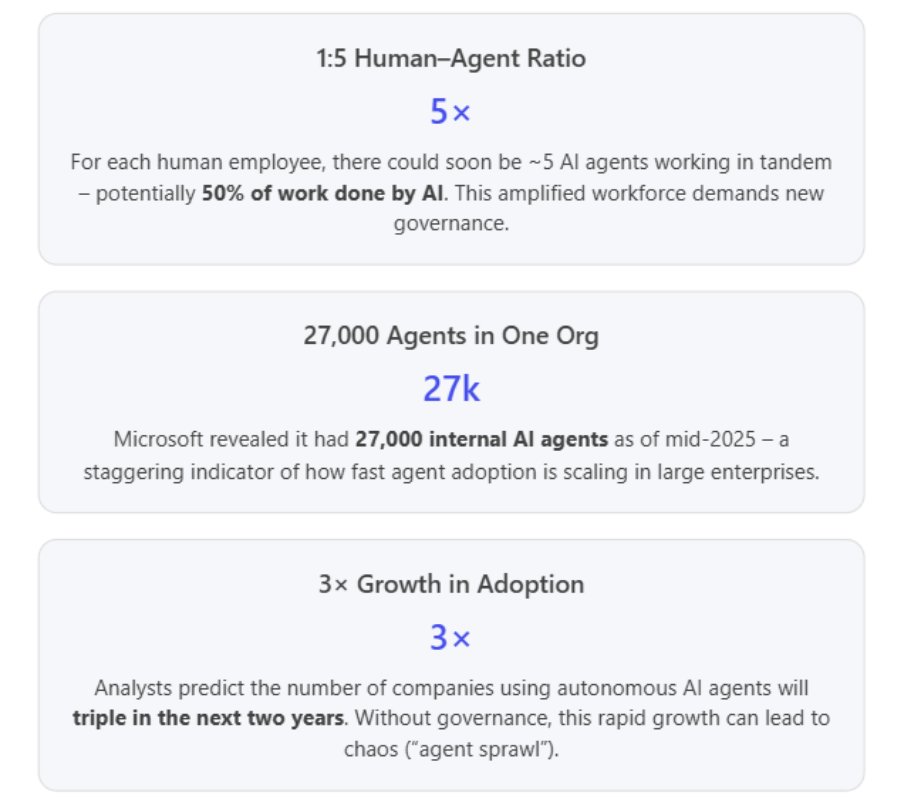
We’re entering an era where AI agents become as common as human employees. Every team and individual might have a fleet of digital assistants – scheduling meetings, drafting content, crunching data, answering customer queries, and more. Microsoft’s own experience is telling: by mid-2025 they had over 26,000 AI agents in active use, with nearly 60,000 unique users interacting with those agents 1. Forward-looking organizations envision a 1:5 ratio between human workers and AI “digital workers” – essentially a fivefold increase in workforce capacity through automation 2. In fact, it’s estimated that at least 50% of work tasks could soon be performed by AI agents rather than people 3.
This explosion is fueled by accessible AI development tools and platforms (from no-code bot builders to advanced multi-agent frameworks). The barrier to creating a custom agent has never been lower. Need a sales assistant bot? A code-generating DevOps script? An HR onboarding agent? Teams can spin these up in days. The result is agent sprawl: dozens or hundreds of bots appearing across an enterprise, often built in silos.
While these agents promise huge productivity gains, unchecked proliferation poses serious challenges. Organizations are already encountering what one might call “shadow AI” – agents running with unclear ownership or permissions, somewhat analogous to shadow IT. Each agent potentially touches sensitive data or executes transactions. Multiply that by thousands of agents and you have a governance nightmare lurking.
Implications of uncontrolled agent growth include:
- Security Risks: An agent with improper access could leak data or execute unauthorized actions. Without oversight, it’s hard to know which agents might become rogue or be exploited by bad actors 4.
- Identity and Access Complexity: Just as every employee has an identity badge and access policy, each agent needs identity and permissions. At scale, managing who (or what) is allowed to do what becomes daunting.
- Cost Overruns: AI agents often call cloud AI services (LLM APIs, cognitive services) or consume resources. A horde of agents running unchecked can rack up substantial costs. Without governance, companies risk expensive surprises from duplicated bots or inefficient use of AI compute 5.
- Compliance and Ethics: Agents might generate content or make decisions that fall foul of regulations or company policy if not properly guided. Highly regulated sectors must account for AI actions – e.g. ensuring a finance-reporting agent follows SOX compliance rules.
- Operational Chaos: Imagine customer-facing agents that give inconsistent answers, or multiple agents unintentionally performing the same task. Lack of coordination can reduce the effectiveness of agents or even create new problems (like contradictory communications sent out by different bots).
In short, the explosion of AI agents brings explosive complexity. Early adopters have learned that simply unleashing agents everywhere is not sustainable – you must impose order and guardrails. This is where Agent Governance comes in. Governance is about getting all your AI agents “on the grid” – visible, accountable, and manageable.
The Case for Governance at Scale: Security, Cost, and Compliance
When an organization has one or two trivial bots, informal management might suffice. But once you have fleets of agents automating business-critical work, governance is non-negotiable 6 7. Here’s why strong governance is essential as AI agent deployments scale up:
- Security & Risk Mitigation: Just as you secure user accounts and devices, you need to secure AI agents. Governance tools can monitor agents for suspicious behavior and shut down compromised or misbehaving agents in real time 8. They also enforce the principle of least privilege – ensuring each agent only accesses the data or systems absolutely necessary for its task. Specialized threat detection for AI (e.g. catching prompt injection attacks on an agent) is emerging as part of governance solutions 9 10. Effective governance prevents “rogue bots” and contains potential damage if an agent goes awry.
- Identity & Access Management: At scale, it’s impractical to manage agent credentials ad-hoc (hard-coding API keys, etc.). A governance framework brings centralized identity management for agents, so you can treat them similar to employees in your directory. This means each agent gets a unique identity with an account in your system, group memberships, and access rights 11 12. Central policies then control what each agent is allowed to do. For example, you might require certain high-impact agents to pass an approval workflow or to “authenticate” via a token for sensitive actions – analogous to multi-factor auth for bots 13. Identity-driven governance lets you instantly disable an agent’s access if something seems off, just like revoking a former employee’s credentials 14 15.
- Cost Management: Governance isn’t only about security – it’s also about monitoring and managing usage. With many agents deployed, organizations need insight into which agents are consuming resources and how that translates to cost. Governance tools can provide analytics on agent activity, such as how often they run, which AI APIs they call, and the compute spend associated with them 16 17. By having a “single pane of glass” for agents, IT can identify redundant agents (perhaps five different teams built similar customer-service bots) and consolidate them to save money. Policies can even enforce cost limits, e.g. flagging an agent that’s making an unusually high number of expensive API calls. In essence, governance stops agent sprawl from becoming a cloud budget buster 18 19.
- Compliance & Policy Enforcement: Enterprises live under various laws and standards – GDPR, HIPAA, internal data handling rules, etc. Without governance, AI agents might inadvertently break compliance, e.g. by exposing personal data in an output or making an unapproved decision. A governance layer can apply compliance checks and policies uniformly. For instance, you could mandate that any agent interacting with customer data must go through a data loss prevention (DLP) filter (thanks to integration with tools like Microsoft Purview) 20 21. Or ensure that every agent’s actions are logged and auditable for later review. Governance also helps with ethical AI practices – for example, ensuring agents clearly identify themselves and don’t operate outside allowed use cases. Essentially, it’s about extending your existing IT governance and compliance processes to cover AI agents 22 23.
- Performance & Quality Control: With many agents, you also want to track which are actually delivering value and which are underperforming. Governance can include setting KPIs for agents and monitoring their outputs. If an agent is supposed to resolve 100 IT tickets a week but is only doing 10, your governance dashboard should highlight that for optimization or retirement. Conversely, high-performing agents can be celebrated and replicated. Moreover, oversight helps maintain quality – e.g. detecting if an agent’s responses start to drift off-policy or accuracy drops, triggering a review or retraining. In this sense, governance and analytics overlap: by analyzing how each agent behaves, organizations can continuously improve their “digital workforce” 24 25.
In summary, governance provides the scaffolding to safely scale your AI agent population. It brings order, security, and accountability to what could otherwise become a digital Wild West. But what does governing AI agents actually look like in practice? The good news is that new platforms and tools are emerging to make agent governance easier. Below, we’ll look at three key pillars of an agent governance stack: an identity layer, a control plane, and a “digital HR” layer – followed by the human organizational piece that ties it all together.
Entra ID for Agents: Giving AI Agents an Identity and Passport
One fundamental component of governing AI agents is treating them as first-class identities in your enterprise. Microsoft has approached this with Entra ID (Azure AD) and the introduction of Entra Agent ID – effectively “digital passports” for AI agents 26 27. The idea is simple but powerful: every AI agent gets its own identity, just like an employee.
Why is this important? Because it lets you apply all your usual identity and access governance to AI agents. With Entra Agent ID:
- Each agent is registered in your directory (Azure AD/Entra) with a unique identity (name, credentials, etc.) 28.
- You can assign roles and permissions to the agent through Entra ID. For example, give a finance-reporting bot read-only access to certain SharePoint sites and Power BI datasets – via the same role mechanism you’d use for a person 29 30.
- Agents can be placed into groups or teams. Entra ID could, for instance, include an “HR Agents” group that grants access to HR files. If an agent isn’t in that group, it can’t see those files 31.
- Conditional Access policies apply to agent identities. You might require that an agent account can only sign in from a specific network or must present a valid certificate – analogous to MFA for non-humans 32 33.
- Lifecycle management of agents becomes feasible. When an agent is deprecated or “retires,” you disable or delete its Entra ID just as you would deprovision an employee account 34. No orphaned credentials lurking around.
- Audit trails and sign-in logs now include agent activities. You can monitor what each agent is doing under its identity – e.g., “InvoiceAgent1 accessed the finance database at 3:00 AM” 35. This provides accountability: if an agent does something unintended, you can trace exactly which identity (and thus which owner/team) was behind it 36 37.
Entra Agent ID essentially brings a Zero Trust approach to AI agents: never trust an agent just because it exists – always verify its identity and enforce policy on every action 38 39. It closes a huge gap. Without a formal identity, many bots would otherwise use shared “service accounts” or embedded API keys that are hard to track and insecure. Entra ID gives each agent an “ID badge” that administrators can manage with familiar IAM (Identity and Access Management) tools 40 41.
Another benefit is integration. Microsoft’s ecosystem is ensuring that agents created through its platforms automatically register with Entra ID 42. Build a Power Platform bot or an Azure AI agent, and it will create an Entra identity as part of provisioning. Microsoft also signaled plans to allow third-party or custom-built agents to be enrolled in Entra ID, so you have one directory of all workforce members – human or AI 43 44.
From a governance perspective, Entra ID becomes the foundation. It’s the identity layer on which other governance measures rely. For example, Agent 365 (which we discuss next) leverages Entra ID to list all agents and their owners 45. When you use Entra ID for agents, you can answer questions like: How many agents do we have? Who “owns” each agent? What systems can it access? And you can enforce answers to Should Agent X be allowed to access System Y? in one central place.
Think of Entra Agent ID as giving your AI agents a “digital persona” within your organization. This ensures accountability and control. If an agent misbehaves, you don’t end up hunting for some token in a config file – you simply disable its Entra account. If a department wants to deploy a new agent, IT can require it be registered in Entra ID first, like registering a new vendor or new hire. Essentially, agents join your company’s security realm and are no longer invisible ghosts in the machine.
In practice, enabling this identity layer is a huge step towards governance because identity is the linchpin of security, auditing, and lifecycle management. Entra ID provides that linchpin for AI agents 46 47, making it possible to scale to tens of thousands of agents with confidence that each one is accounted for.
Agent 365: The Central Control Plane for AI Agents
To manage the deluge of agents across an enterprise, Microsoft introduced Agent 365, a unified control plane and governance platform for AI agents 48 49. If Entra ID gives agents an identity, Agent 365 is the system that watches over those identities in action, providing a central console to govern, monitor, and manage all AI agents across the organization, no matter where they were built.
Think of Agent 365 as analogous to an “agent management” version of Intune or Active Directory admin center – but instead of managing PCs or user accounts, you’re managing AI bots 50 51. Here are the key functions Agent 365 provides:
- Agent Registry (Inventory): Agent 365 maintains a catalog of every AI agent in your organization 52 53. This includes agents built in Microsoft tools (like Copilot plugins, Power Virtual Agents, Azure bots) and, importantly, it can include external or custom agents too. The registry becomes your single source of truth – you can see all agent names, descriptions, owners, and status in one place. This tackles the “unknown bot” problem: with Agent 365, there should be no stealth agents lurking in the shadows because anything not in the registry is automatically flagged as an outlier (and can be quarantined) 54.
- Access Control and Policy Enforcement: Through integration with Entra ID, Agent 365 lets you set policies on what each agent can access or do 55 56. For example, you can define an access policy for a class of agents (say all customer service bots) limiting them to only query certain databases and APIs. If an agent tries to step outside its allowed boundary, Agent 365 can block it in real time 57 58. You can also enforce organization-wide rules: e.g., “No agent is allowed to run between 1am–5am without approval” or “Agents must not output SSN or credit card numbers” – analogous to how mobile device management enforces conditional policies on devices. Essentially, Agent 365 is the guardrail system, making sure agents operate within approved guardrails for data access and functionality 59 60.
- Security & Threat Detection: Agent 365 ties into security tools (like Microsoft Defender for Cloud, etc.) to provide threat monitoring specifically tuned for AI agents 61 62. For instance, it can detect if an agent is sending unusually large amounts of data out of the network (possible data exfiltration) or if an agent suddenly starts taking actions outside its normal pattern – which might indicate it’s compromised or malfunctioning. It also integrates with Microsoft Defender and Purview to get signals like DLP alerts or suspicious usage patterns 63 64. If an issue is detected, administrators can use Agent 365 to quarantine or disable an agent instantly 65. This security focus is crucial given the new attack surfaces AI agents introduce.
- Usage Analytics & Performance: Agent 365 provides dashboards and reports on agent usage across the org 66 67. You can track metrics like how many users engage with agents, how frequently each agent is invoked, success/failure rates of agent tasks, and more. It might show, for example, that Agent X handled 1,200 support tickets this month, or Agent Y hasn’t been used in 60 days. These insights help in understanding ROI and impact. Leaders can identify which agents are most valuable and ensure they get the right resources (or conversely, decide to retire low-value ones). Analytics also highlight adoption trends: e.g. a 28% week-over-week increase in total agents in use 68 could signal accelerating demand that the CoE needs to support.
- Visualization of Relationships: A unique aspect of Agent 365 is mapping how agents relate to data, systems, and people 69 70. For instance, it can graphically show which human users or departments “own” which agents, and what data those agents touch. This helps spot dependency risks (e.g., many critical processes rely on one agent) and encourages reuse (seeing that Team A built an agent that Team B could also use). Visualization brings clarity in a complex web of interactions: imagine a graph that links an agent to the SharePoint sites, databases, and even the specific humans that interact with it – giving a full context of its footprint 71 72.
- Interoperability and Integration: Agent 365 isn’t just a standalone cage for agents; it’s designed to let agents work together and integrate with your apps in a governed way 73. It provides frameworks or APIs so that agents registered in the system can call each other’s capabilities (with oversight). For example, a sales agent might invoke a finance agent to generate an invoice, and Agent 365 would log and govern that interaction. It also connects into developer platforms – meaning if you build custom agents in Azure or other systems, they can publish into Agent 365’s registry easily 74. This interoperability ensures that even if you have a mix of Microsoft and non-Microsoft AI agents, you can manage them under one umbrella.
In essence, Agent 365 extends enterprise IT management to cover AI agents, treating them as managed entities rather than wild scripts 75 76. As one Ignite summary put it, “Microsoft wants to manage agent sprawl the same way it manages user identities and devices” 77. By plugging into Entra ID for identity, Defender for security, and Purview for compliance, Agent 365 becomes a single pane of glass to control agents across their lifecycle 78.
For businesses, the value is trust and scale: you can allow teams to create and deploy lots of agents because you have central oversight to keep them in check 79. CIOs and CISOs gain confidence that no agent is running with “who-knows-what” permissions or doing something off the radar 80. Every agent has an owner, a purpose, and guardrails. This mitigates the risks of “agent sprawl” (uncontrolled proliferation) and actually enables more adoption of AI agents – because with Agent 365 in place, IT can say “yes, go ahead and build that bot, we’ll onboard it into our governance framework” instead of fearing it 81 82.
From a cost and operations standpoint, Agent 365 also helps avoid duplication and inefficiency. If two departments build similar agents, it will be visible and you can rationalize. If an agent is running up high costs, you’ll see it in the usage stats and can optimize or put limits. By centralizing knowledge of all agents, organizations avoid the left hand not knowing what the right is doing. This is analogous to early days of cloud adoption when everyone spun up VMs everywhere – until companies established cloud governance and central management to rein things in. Agent 365 is fulfilling that role for the AI agent era.
In summary, Agent 365 is the nerve center of agent governance: inventorying agents, enforcing policies, monitoring activity, and integrating with security/compliance tools 83 84. It’s the technology that makes large-scale agent deployments feasible without losing control.
Digital Worker IQ: The “HR Department” for AI Workers
So far we’ve covered the identity layer (Entra ID) and the technical control layer (Agent 365). These ensure agents are cataloged, secure, and within guardrails. But there’s another critical aspect to governing an AI workforce: managing them in terms of business performance, roles, and value – much like you manage human employees. This is where Neudesic’s Digital Worker IQ (DWIQ) comes into play.
Digital Worker IQ can be thought of as the Human Resources layer for digital workers (AI agents) 85 86. If Agent 365 is used by your IT admins and security team, Digital Worker IQ is used by your operations managers, process owners, and HR/innovation teams to ensure AI agents are delivering business results and are “well-behaved” contributors to processes. It complements the IT governance by adding structure, oversight, and optimization from a business perspective.
Key aspects of Digital Worker IQ include:
- Role Definition and Onboarding: Just as HR defines job roles for employees, Digital Worker IQ helps define “agent roles” in the organization. For example, you might have a role like Accounts Payable Digital Worker or Customer Service Virtual Agent. Each role has a scope of responsibilities and performance expectations 87 88. When a new AI agent is created, it’s onboarded into one of these roles – meaning it gets a clear mandate of what it should do, who its “manager” or owner is, and what success looks like for that agent. DWIQ provides a framework to assign tasks and processes to agents in a structured way 89 90. This mirrors how a new employee gets oriented to their job; an agent gets oriented to its task domain and integrated into the workflow.
- Performance Management (KPIs & Metrics): Human employees have KPIs and performance reviews – digital workers should too. Digital Worker IQ helps organizations define metrics for each digital worker’s performance and track them continuously 91. For instance, an AI sales assistant agent might be measured on how many leads it qualifies per week, or the customer satisfaction score of its interactions. DWIQ dashboards can show these metrics, enabling a form of performance review for agents. If an agent isn’t meeting the targets, it might need retraining or tuning (analogous to coaching or upskilling a human) or perhaps decommissioning if it’s not adding value. Conversely, high-performing agents can be celebrated and used as models for additional bots. By quantifying the value each agent provides (or the effort it saves), Digital Worker IQ links AI activities to business outcomes like time saved, cost reduced, revenue generated, etc. 92 93.
- Governance & Safety Policies (from a process POV): While Agent 365 enforces technical policies, Digital Worker IQ enforces business process rules and ethical guidelines. For example, DWIQ might ensure that a “human-in-the-loop” checkpoint is present for certain critical agent decisions – e.g., an AI loan approval agent must get human sign-off for loans above a certain amount 94. It can log when agents deviated from expected process (maybe an agent skipped a step or took an unusual action) so that process owners can investigate. Essentially, DWIQ sets the operational guardrails: when in a process should a human intervene, what parts of a process are agents allowed to automate vs. where should they defer to humans, etc. 95 96. It treats digital workers as members of the workforce that need oversight and adherence to company values and procedures.
- Alignment with Business Goals: An HR department ensures employees align with company goals; Digital Worker IQ ensures your scattered AI initiatives align with strategic business outcomes. It can help prioritize where to deploy agents for maximum impact (evaluating potential value vs. risk vs. effort of automating a given process) 97. For example, DWIQ might maintain a roadmap of digital worker deployments: which processes are slated to get AI agents next, which business units need more automation, etc., thus providing an enterprise-wide strategy for scaling digital labor. It keeps the focus on business value first – making sure that behind every AI agent there is a business justification and a way to measure its contribution 98.
- Lifecycle and Continuous Improvement: DWIQ treats AI agents as evolving “employees.” This means managing their training, updates, and eventual retirement. In humans, you’d do training programs; for AI agents, DWIQ coordinates re-training on new data or upgrading them as AI models improve. It might schedule regular review meetings (yes, a sort of team meeting for your AI agents!) where their performance data is reviewed by a human team lead and the next steps are decided (tweak prompts, add knowledge, etc.). DWIQ ensures that the organization doesn’t “set and forget” an agent – they are continuously evaluated and improved just like you’d mentor an employee to grow in their role 99 100. When an agent becomes obsolete (say a process changed fundamentally or a better bot is in place), DWIQ oversees its decommissioning so that it’s removed from the registry and its access revoked (in coordination with Agent 365/Entra).
In short, Digital Worker IQ brings human-style workforce management to AI agents. As Neudesic describes it, “The digital workforce requires a new operating model. We are the human resources department for virtual agents.” 101. This perspective is crucial because it addresses aspects technology platforms alone might miss: accountability, clarity of purpose, measurement of results, and integration into business operations.
By implementing a layer like DWIQ, companies can avoid a common pitfall: deploying a bunch of AI agents without understanding if they’re actually helping. DWIQ forces the question: What business value is this agent delivering, and how do we know? It also assigns human responsibility for each agent’s success (e.g., a business owner or product manager for the agent) who will use the DWIQ insights to adjust the agent’s work. In many ways, Digital Worker IQ turns AI deployment from a tech project into a true workforce strategy.
How DWIQ complements Agent 365: The question isn’t choosing one or the other – you want both. Agent 365 and Entra ID handle the IT-side governance, ensuring agents are safe, compliant, and technically under control. Digital Worker IQ handles the business-side governance, ensuring agents are effective, serving the right purpose, and being managed for performance. For example, Agent 365 might tell you “Agent X accessed System Y 200 times and is healthy”, while DWIQ tells you “Agent X completed 1800 transactions which saved 300 hours of manual work and met its KPI targets”. Together, you get a full picture. In fact, Neudesic is working to integrate DWIQ with Agent 365’s registry – so that for every agent in Agent 365, you could link to its DWIQ profile with business metrics 102 103. This marriage of IT and business information is the ultimate goal: a governed AI workforce that is secure and effective.
Human Centers of Excellence: The Organizational Layer
The final piece of the puzzle is not a software tool at all, but an organizational structure and culture. To successfully govern a legion of AI agents, enterprises are establishing AI Centers of Excellence (CoEs) and cross-functional governance committees. Technology can enforce rules, but people must set the policies, monitor outcomes, and continually adapt strategies.
Here’s what the human governance layer often entails:
- AI Governance Board or CoE: Many companies set up a cross-functional team (CoE) dedicated to AI governance and innovation 104. This typically includes stakeholders from IT, security, data governance, compliance, HR, and business units. The CoE’s role is to develop governance policies, best practices, and standards for AI agent development and deployment 105 106. For example, they might create an “AI Agent Governance Policy” that stipulates: all agents must be registered in Agent 365; any agent that interacts with customers must go through additional review; here’s the approved tech stack for building agents; here are coding guidelines for prompt engineering to ensure consistency, etc. The CoE also evaluates new tools and keeps the organization updated on emerging risks and opportunities in the AI agent space.
- Change Management and Training: An AI CoE will drive training programs and culture change so that employees know how to work with and oversee digital workers. This includes educating developers on how to build agents securely (e.g., avoiding hard-coded secrets, handling exceptions properly) and training business teams on how to use analytics dashboards (like Agent 365 and DWIQ) to supervise agents 107. They may introduce “digital worker supervisors” roles – employees who act as managers for certain agents day-to-day. Essentially, the CoE ensures organizational readiness: that everyone from leadership to frontline staff understands their role in a human+AI workforce and feels empowered to raise issues or ideas around agent deployment.
- Process for Approvals and Reviews: Governance is not about stifling innovation, but some oversight process is wise. Many organizations implement a lightweight approval workflow for launching new agents. For instance, a team proposes a new agent, the CoE (or a sub-group) reviews it for alignment to strategy and risk, then it gets a green light. Likewise, there might be periodic reviews of existing agents – similar to how companies do user access recertification or project portfolio reviews – to decide if each agent is still needed and performing well. The CoE often coordinates these reviews, using data from Agent 365 and DWIQ to inform decisions.
- RACI and Ownership: With so many moving parts, clarity on who is responsible for what is crucial. A solid governance model will define RACI matrices (Responsible, Accountable, Consulted, Informed) for AI agent management 108. For example, who is accountable if an agent makes a mistake? (Maybe the business owner of that process.) Who is responsible for fixing an agent that breaks? (Maybe the central AI engineering team.) The CoE helps assign and document these roles. Often a product owner is assigned per major agent or agent platform, ensuring there is a human “parent” watching over each digital “child.” When everyone knows their role, you get both agility and control – teams can move fast within their domain, and the CoE connects the dots to avoid gaps or overlaps.
- Ensuring Agility and Innovation: A paradox of governance is that too heavy a hand can slow progress. A good CoE recognizes this and strives to enable agility while keeping guardrails. They might, for instance, provide templates, tools, and sandboxes for teams to experiment with new agents safely. Or maintain a catalog of approved foundational models and plugins teams can use – so they don’t have to reinvent the wheel (but also don’t introduce unvetted tech). The CoE can sponsor hackathons or pilot programs to encourage innovation in a controlled way, and then rapidly codify learnings into the governance framework. The goal is to support the explosion of AI agents, not to become a bottleneck. In fact, companies increasing their AI budgets and projects often distribute that investment across departments, with CoEs guiding rather than micromanaging 109 110. An effective mantra is: “Centralize guardrails, decentralize execution.” The CoE sets the guardrails, and business units can run with their AI ideas within those bounds.
- Continuous Monitoring and Adaptation: Finally, the human governance layer is about constant adaptation. The AI landscape evolves quickly – new risks (e.g., novel prompt injection attacks) and new opportunities (e.g., more powerful models, better tools) emerge every month. The CoE or governance board needs to continuously monitor external developments and internal outcomes. This might mean updating policies (perhaps allowing a new class of agents that were previously banned as technology matures), responding to incidents (if something goes wrong with an agent, performing a post-mortem and refining practices), and measuring the overall program success (are we actually seeing productivity gains? where do we hit friction?). Many leading firms conduct regular audits of their AI agents – checking compliance, bias, security, etc., often spearheaded by the CoE. The CoE becomes a permanent institution that evolves the governance model in sync with the AI journey.
In practice, organizations like the “Frontier Firms” (AI-forward companies) have indeed established this kind of comprehensive approach: broad AI adoption paired with strong governance and cross-functional investment 111 112. For example, one survey showed 71% of such firms increasing AI budgets across departments while also building cross-functional AI fluency and oversight 113 114 – meaning they put money behind AI but also behind training and governing it. Those companies treat AI agents as a company-wide transformation, not just an IT project, and set up the human structures to manage it accordingly.
To summarize, the technology layers (identity, control plane, HR for AI) provide the tools to govern AI agents, but human governance structures provide the strategy and policy. By establishing an AI CoE and clear ownership, businesses create a culture of responsible AI use. This ensures that as the number of agents grows, they remain aligned to the business’s goals and values, and the organization can adapt policies as needed. It’s the combination of tools + process + people that truly delivers effective agent governance.
Bringing It All Together: A Governance Stack for the AI Frontier
We’ve covered a lot of ground. Let’s recap how these layers work in concert to enable effective Agent Governance at scale:
By implementing these layers, an enterprise creates a comprehensive governance stack for AI agents. Entra ID secures the identity. Agent 365 secures the operations. Digital Worker IQ secures the outcomes. And the CoE secures the strategic alignment. Each layer reinforces the others:
- Entra ID gives Agent 365 the hooks to control access.
- Agent 365 feeds DWIQ with usage data and ensures agents abide by IT rules.
- Digital Worker IQ feeds the CoE with business impact data and ensures agents abide by business rules.
- The CoE in turn refines identity policies, Agent 365 settings, and DWIQ metrics based on the organization’s changing needs.
This multi-layered approach is how leading companies are safely scaling to thousands of AI agents. They can reap the benefits – massive productivity gains, 24/7 intelligent automation, improved decision-making – without sacrificing security, compliance, or quality.
Conclusion: Confidently Embracing the AI Workforce
The number of AI agents in enterprises is set to skyrocket, heralding a new era where digital workers operate alongside human workers as part of hybrid teams. The potential upside in efficiency and capability is enormous: routine tasks handled automatically, employees supported by ever-watchful assistants, and entirely new processes powered by autonomous agents. But realizing this potential requires diligent governance. Unchecked agent sprawl could lead to security breaches, wasted costs, and chaos that undermines trust in AI.
Fortunately, we have a clear path to governance that scales. By giving agents proper identities (Entra ID), managing them through a central control plane (Agent 365), measuring their business performance (Digital Worker IQ), and establishing human oversight (CoE and best practices), organizations can unlock the value of an AI-augmented workforce while maintaining control. Governance is not the enemy of agility – it’s what permits agility at scale. It’s the guardrails on the highway that let you drive faster safely.
For IT leaders, this means investing in the right platforms and frameworks now. For business and HR leaders, it means preparing your organization’s structures and culture for a world where “every human will have at least five digital workers” assisting them 115. Security architects should extend zero-trust models to non-human actors, and data governance teams should incorporate AI outputs into compliance monitoring. Meanwhile, innovation teams can move forward knowing that a strong governance foundation will catch issues early and allow them to experiment responsibly.
In short, Agent Governance is about treating AI agents as an integrated part of your enterprise rather than an ad-hoc add-on. It’s the difference between a chaotic bot explosion and a strategic expansion of your workforce with digital talent. With governance in place, you can confidently scale up the number of agents, delegate more to them, and even explore frontier possibilities (fully autonomous business processes, anyone?) – because you have visibility and control every step of the way.
The age of AI agents is here. Those organizations that embrace it with governance and foresight will multiply their capacity and leap ahead. Those that ignore governance may find their AI dreams stuck in pilot purgatory or, worse, causing harm. By implementing the layers of identity, control, performance management, and human oversight we discussed, you equip your enterprise to ride the coming wave of AI agents, not get swept away by it. With the proper governance, you can welcome an army of digital workers into your business – onboarded, trained, and supervised – ready to propel your organization into the future of work with confidence and agility.
 Nathan Lasnoski