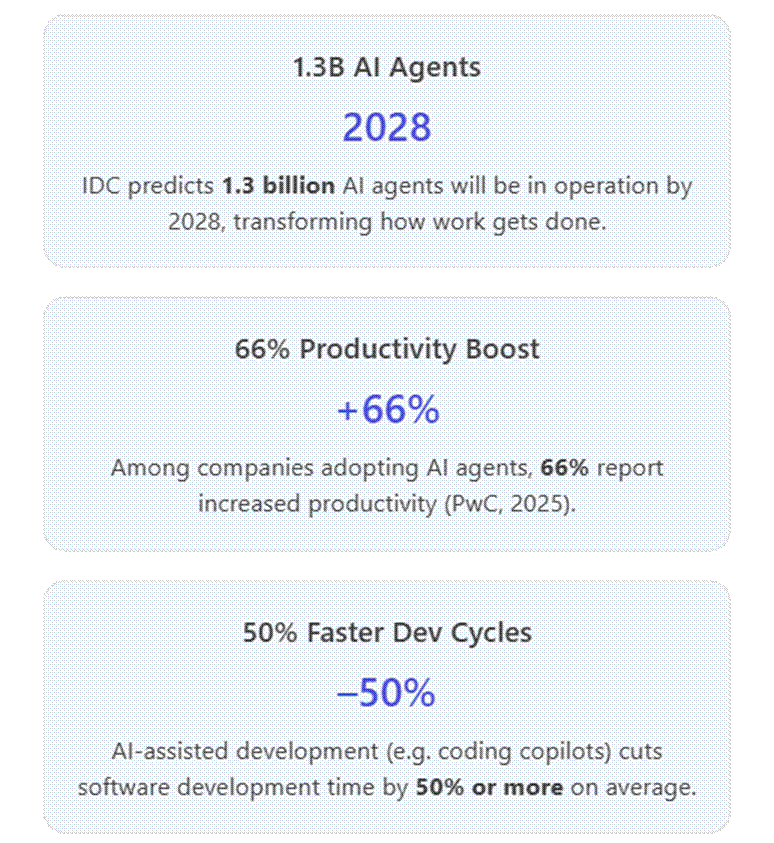
2026 promises to be a pivotal year for enterprise IT leadership. CIOs are expected to drive innovation and business value amid an AI-powered transformation of work. Across industries, organizations are racing to modernize legacy systems, operationalize artificial intelligence for efficiency, and create new digital revenue streams. According to a recent survey, 79% of companies have already adopted AI “agents” (intelligent assistants or automation bots) in some form, and 66% of those report measurable productivity gains from these agents [PwC’s AI Agent Survey, 2025]. This rapid adoption signals that AI and data-driven solutions are no longer optional – they’re central to staying competitive. As a CIO, focusing on the right strategic areas will determine whether your organization leads or lags in this new era.
Below, we organize the nine key focus areas for CIOs in 2026 into three strategic themes: De-risk and Modernize Legacy, Gain Real Operational AI Efficiencies, and Scale and Grow New Revenue. Each theme addresses a critical aspect of leveraging technology for maximum business impact. Let’s dive into each area and why it matters for the year ahead.
Theme 1: De-Risk and Modernize Legacy
Modernizing legacy systems and practices is a foundational priority. Without a secure and agile foundation, new innovations can’t take root. In 2026, CIOs must de-risk legacy technology by governing the emerging AI workforce, unifying data platforms, and reinventing development processes. These first three focus areas ensure your organization’s core tech is robust, secure, and ready for the future.
1. Governing and Securing Agent Scale
The rise of AI-powered “digital workers” or agents is accelerating. From chatbots to workflow assistants, these agents act as virtual team members – and their numbers are exploding. Microsoft estimates that by 2028, over 1.3 billion AI agents will be at work in the background of businesses worldwide https://www.itpro.com/business/1-3-billion-ai-agents-2028-microsoft]. In practical terms, enterprises might soon have a ratio of 1 human to 5 AI agents (or more) augmenting their workforce. This agent proliferation promises huge productivity gains, but it also creates a new challenge: governance at scale. How do you manage and secure hundreds or thousands of semi-autonomous software agents throughout the enterprise?
CIOs in 2026 need a plan for AI agent management and security. This includes implementing an identity and access framework for non-human actors. Just as every employee has an ID and permissions, each important AI agent should have a unique digital identity and defined access rights. Tools like Entra ID for AI agents (announced by Microsoft as “digital passports” for bots) are emerging to address this need, ensuring that agents operate within Zero Trust security principles [Microsoft Entra Agent ID]. By assigning credentials and enforcing role-based access for agents, CIOs can prevent “rogue” AI actions and ensure accountability for what agents do.
Another key is establishing a central control plane for AI agents. Consider adopting an Agent Management platform (such as Microsoft’s new Agent 365). These platforms serve as an “AI workforce directory” – a registry of all agents running in the organization, with dashboards to monitor their activities and performance. With a centralized governance layer, IT can catalog agents, set policies, monitor usage, and quickly quarantine or update agents that misbehave or become outdated. Essentially, it extends your IT management practices (monitoring, compliance, lifecycle management) to cover AI-driven software actors in addition to human users and devices.
Security is paramount when scaling up agent usage. CIOs should implement strong oversight and testing for AI behaviors. This might involve automated adversarial testing – for example, using an AI Red Teaming agent that continuously probes your AI models and bots for vulnerabilities or biases before they are deployed broadly. By stress-testing AI agents in-house (simulating attacks, bad data inputs, or compliance edge cases), you can catch potential issues early and harden your AI systems against threats. In addition, leverage your existing security stack (SIEM, IAM, DLP, etc.) to create alerts and guardrails specific to AI activities. Many security tool vendors are adding capabilities to detect things like prompt injection attacks or data leakage via AI outputs. Make sure your security operations center knows how to monitor AI agent activity just as they monitor network or user activity.
Overall, treat AI agents as a new class of workforce. Develop policies for their “hiring” (development or procurement), “training” (fine-tuning on data), performance evaluation, and even “termination” if an agent is outdated or untrusted. Governance at agent-scale will prevent chaos as automated agents multiply. With the right controls in place, CIOs can confidently deploy more AI helpers knowing they won’t compromise security or compliance. The payoff is enormous: when each employee is amplified by a team of well-governed AI assistants, the organization can achieve productivity breakthroughs without losing oversight.
2. A Scaled Data Platform with One Ontology
Enterprise data is the fuel of AI – but many CIOs find their data scattered across silos, in inconsistent formats, and governed by fragmented rules. In fact, Gartner has noted that 65% of organizations today either lack “AI-ready” data or aren’t sure if they have it (underscoring how data complexity hampers AI projects) [Experteq Trends 2026]. In 2026, a top focus for CIOs will be building a scaled data platform that unifies data assets and establishes a common ontology (i.e. a shared data vocabulary and model) across the business.
Why “one ontology”? As AI becomes pervasive, different systems and teams must speak the same data language. A unified ontology means that critical business entities – customers, products, orders, sensors, etc. – are defined consistently in all databases, applications, and AI models. Instead of each system having its own slightly different definitions (leading to endless data wrangling), the organization maintains a semantic layer that maps disparate data sources to a single logical model. This greatly simplifies integration and ensures that insights derived from one part of the business are meaningful company-wide. For example, if sales, finance, and support systems all reference the same canonical customer and contract definitions, an AI agent can seamlessly pull information from all three to answer a question or drive a workflow.
To achieve this, CIOs should invest in modern data architecture components that emphasize semantic consistency and scalability. One approach gaining momentum is the “data fabric” or “data mesh” concept – essentially, a distributed data platform that connects multiple repositories but layers a knowledge graph or ontology on top. For instance, Microsoft’s introduction of Fabric IQ (the intelligence layer for its Azure Data Fabric) is one example: it uses an ontology to unite data across services like Azure, Databricks, and Snowflake, enabling AI agents to query data in a uniform way across all sources. Other vendors and open-source initiatives are also pushing semantic layer technologies. The goal is to let organizations have agility in how they store/process data (e.g. cloud data lakes, warehouses, real-time streams) while enforcing consistency in how data is defined and accessed.
In practical terms, CIOs should pursue several steps:
- Consolidate and virtualize access to data: Reduce isolated data silos by introducing a data lake or virtualization layer (e.g. a “OneLake” in Microsoft terms) that can access data from various sources without duplicating it. Recent advancements like zero-copy data sharing allow data to be stored once and used across platforms, cutting storage costs and ensuring everyone accesses the same single source of truth rather than outdated exports.
- Establish a enterprise data ontology: Work with business and data governance teams to define key business concepts and their relationships. Utilize tools or platforms that support modeling these concepts (for example, creating a central business glossary and metadata repository). Metadata management and data cataloging tools (like Azure Purview, Collibra, etc.) can help automate the discovery and alignment of schema across databases. The result should be an agreed-upon data dictionary/knowledge graph the AI systems will rely on.
- Implement semantic query and AI integration: Once an ontology is in place, leverage AI data services that can use it. For example, conversational data query agents (AI that allows users to ask natural language questions about data) perform much better when backed by a semantic layer – they can interpret that “client” and “customer” mean the same entity, or automatically join data across tables because the ontology guides them. Ensure your BI tools, data science platforms, and AI agents are connected to this semantic layer so that a question asked in one department yields consistent answers from another.
- Enforce data governance and quality end-to-end: A unified platform doesn’t mean much if the data is untrustworthy. Integrate data lineage tracking and data quality checks into your pipeline. As data flows from source to the central platform, use governance tools to automatically tag sensitive information (using DLP – Data Loss Prevention – rules to protect PII, for instance) and to track who is using what data. With many employees and agents accessing data, automated governance (policies as code) is crucial. It will ensure compliance requirements are met and build trust in the data. Users and AI alike should know whether a dataset is certified, how recent it is, and what it represents.
By building a scaled, ontology-driven data platform, CIOs set the stage for advanced analytics and AI capabilities. When data is agile (easily accessible), business-aligned (anchored in business meaning), and unified (consistent), organizations can rapidly develop AI models, perform predictions and generate insights that span the entire enterprise. In concrete terms, this means analysts spend less time reconciling reports, AI projects spend less time prepping and cleaning data, and executives get a single version of the truth. In 2026, moving toward a single semantic data foundation will differentiate those companies that can execute AI initiatives at scale from those that remain stuck in pilot purgatory due to data confusion.
3. Re-Imagining SDLC to Address Legacy Environments
Many CIOs carry the burden of decades-old legacy systems: monolithic applications, outdated codebases, and slow manual processes in software delivery. At the same time, the software development landscape is being revolutionized by AI. In 2026, CIOs must re-imagine the Software Development Life Cycle (SDLC) – not only to modernize legacy systems, but to transform how new software is built and maintained going forward. The imperative is to infuse AI and automation into development, so that legacy modernization is accelerated and future applications don’t become the legacy of tomorrow.
AI-Augmented Development: One of the most impactful trends is the adoption of AI pair programmers and code-generating copilots. By late 2025, studies showed that over 80% of developers had started using AI coding assistants (like GitHub Copilot, ChatGPT code plugins, etc.) regularly, with these tools helping developers complete tasks 50% faster on average [Index.dev Developer AI Survey]. This means that coding, debugging, and even testing can be done in a fraction of the time it used to take. CIOs should ensure their development teams are leveraging these tools to speed up delivery and reduce the manual effort in writing boilerplate code or tests. But re-imagining SDLC goes beyond just giving developers Copilot; it’s about changing processes to fully harness these capabilities.
One approach is to embrace spec-driven development and generative SDLC. Instead of the traditional cycle where human developers write every line of code from requirements, forward-looking teams now create high-level specifications or models (for example, using UML diagrams, declarative configs, or natural language descriptions of functionality) and let AI-assisted engines generate the application code. For instance, Microsoft’s concept of “GitHub Copilot in Agent Mode” paired with a tool called SpecKit allows an AI agent to take software specs and scaffold out entire projects. These AI agents can produce initial code, set up frameworks, and even regenerate or refactor code automatically when requirements change. In practice, this could mean reducing the time to produce working software by well over 50% – something that was highlighted at recent conferences where case studies showed dramatic reductions in development timelines when AI took on the heavy lifting of coding. Every data and software project in 2026 should ask, “How can we use AI to do this faster and better?” – whether it’s using an AI to generate a data pipeline, auto-create documentation, or suggest improvements in a code review.
For legacy environments, an AI-augmented SDLC is a game-changer. Many legacy systems (think COBOL mainframes, old Java apps, sprawling ERP customizations) desperately need updates or migration, but manual rewriting is too slow and risky. Now, AI code translators can analyze legacy code and help port it to modern languages or architectures. For example, there are AI tools that can ingest COBOL code and output functionally equivalent code in C# or Java (with a human validating). Similarly, AI can read an outdated module and generate a suite of unit tests for it, which never existed before – making it safer to refactor. CIOs should pilot these capabilities on contained projects to build confidence. Some companies are already using generative AI to document and refactor millions of lines of legacy code, accelerating cloud migration efforts that would have taken years by hand.
However, re-imagining the SDLC isn’t only about coding – it’s also about process and culture. Continuous integration and deployment (CI/CD) pipelines should be upgraded to incorporate AI at every stage. For instance, test suites can be enhanced with AI-generated test cases, and CI bots can automatically analyze build failures or suggest fixes. AI ops tools can monitor applications in production and proactively create bug fix patches. Essentially, software development and maintenance becomes a human-machine collaborative loop: humans define goals and review outputs, while AI handles a lot of the brute-force generation and analysis. This can dramatically shorten release cycles – perhaps turning monthly releases into daily releases for systems that were once considered too critical to touch frequently.
Crucially, governance and quality assurance must evolve alongside. With AI creating code, CIOs must implement “guardrails” to ensure security and compliance requirements are embedded. This means extending your code review practices to include AI outputs – for example, using AI itself to scan for vulnerabilities or policy violations. (Notably, Gartner analysts have advised that governance be part of any AI development transformation – security guardrails should be baked in as code is produced, not after the fact.) It’s wise to maintain a human-in-the-loop for final reviews on anything safety-critical, at least until AI proves consistently reliable. But remember that AI can often catch mistakes humans miss, so a combination of automated and manual checks will yield the best results.
By re-imagining your SDLC now, you address legacy risk on two fronts: first, AI-powered efforts can rapidly upgrade or encapsulate old systems (for example, wrapping legacy functionality with new APIs or microservices generated by AI, so you modernize the interface without rewriting everything at once). Second, any new software your organization develops will be created with modern, AI-assisted techniques – meaning it’s produced faster, with fewer defects, and in a way that’s easier to maintain. In 2026, the CIO’s job is to champion these new development practices, upskill the IT workforce to collaborate with AI, and set targets for legacy modernization sprints using these tools. The reward is a tech environment that is more agile, less brittle, and readily adaptable to business needs – and far fewer nightmares about that 20-year-old system breaking, because you’ve finally been able to replace or rejuvenate it.
Theme 2: Gain Real Operational AI Efficiencies
With a solid foundation in place (governance, data, and modern dev practices), CIOs can turn their attention to operational efficiency – using technology to make the organization run smarter and leaner. The next three focus areas center on embedding AI into everyday workflows and processes to unlock productivity for everyone, not just IT or data scientists. This is about moving beyond pilots and isolated use cases to achieve AI-driven efficiency at scale. In 2026, CIOs should ensure that every employee is empowered by AI tools, that purpose-built agents are transforming key business processes, and that multi-agent systems are automating complex operations. These efforts target cost savings, speed, and quality improvements across the enterprise.
4. Achieving Productivity for Everyone
One of the most tangible opportunities of AI is boosting individual and team productivity. Over the past year, we’ve seen the advent of AI copilots for office work – from drafting emails and creating presentations to summarizing meetings. However, 2026 will be the year this goes from novelty to ubiquity. CIOs must focus on achieving productivity for everyone by integrating AI assistants into the daily tools of every employee and raising the digital skill floor so that all staff can leverage these AI helpers.
Imagine a near-future scenario: every employee has 5 AI agents at their disposal, each specialized in a different domain – one for scheduling and administrative tasks, one for research and information retrieval, one for data analysis, one for writing and content creation, and maybe one embedded in their functional software (sales, finance, HR) providing expert guidance. This isn’t far-fetched – in fact, forward-looking companies are already predicting that 50% or more of an average worker’s tasks could be handled by digital workers/agents in the next few years. The result could be massive productivity gains and the ability for employees to focus on high-value work. As CIO, your role is to make this a reality in a way that’s seamless and inclusive.
Here’s how to drive it:
- Deploy AI assistants enterprise-wide: Ensure that the AI capabilities offered by platforms like Microsoft 365, Google Workspace, or others are fully enabled and adopted. For example, Microsoft 365’s Copilot (with Workplace “IQ” context) can now act across Outlook, Teams, Word, Excel, etc., to help generate content or answer employee queries. Such tools should be rolled out beyond pilot groups and into the hands of every knowledge worker (with appropriate training). Consider licensing or building similar copilots for employees who don’t sit at desks – like field technicians using mobile assistants for diagnostics, or retail staff using AI on handhelds for customer answers. The aim is no employee left behind in the AI productivity boost.
- Promote digital literacy and AI training: Productivity gains will remain unrealized if employees don’t know how to use their new AI tools effectively. Invest in change management: provide hands-on workshops and micro-learning on how to converse with generative AI, how to craft effective prompts, and how to review AI outputs critically. The workforce needs to shift from doing everything manually to orchestrating work with AI – which is a new skill set (sometimes called “AI fluency” or “prompt engineering lite”). Companies that cultivate this will see much higher ROI on their AI investments. Employees should feel comfortable asking an AI assistant to draft an analysis or create a first version of a PowerPoint deck, just as they would feel comfortable using a search engine or a spreadsheet today.
- Integrate AI into workflows and legacy processes: It’s not enough to have an AI chat tool on the side; to truly save time, AI needs to be built into the flow of work. This might mean adding an “Ask AI” button in your CRM or ERP system, so users can get instant insights without switching context. Or using an AI agent to auto-fill forms, update databases, or route tasks based on content. A great example is Project Opal, an automation agent that Microsoft described, which can take multi-step tasks (like updating records, sending follow-ups, logging into systems) and execute them behind the scenes once triggered – acting like a virtual personal assistant that not only writes suggestions but actually takes actions. Evaluate processes where employees spend a lot of time on routine digital admin work (filling timesheets, compiling reports, copying data between systems) and see if an AI agent could handle those chores. Freeing people from “busywork” translates immediately into productivity (and morale) improvements.
- Measure and communicate results: To ensure “productivity for everyone” isn’t just a slogan, measure the impact. Use analytics from your AI tools (e.g., Copilot usage dashboards) to see adoption rates. Survey employees about time saved. Identify success stories: for instance, a team that was able to increase the number of customer proposals they produce by 30% because AI handles the first draft of each proposal. Share these wins across the company to encourage further usage and to pinpoint where the AI assistants are most effective (and where they may need refinement or additional training data).
The benefit of focusing here is not just internal efficiency but also employee satisfaction and innovation. When employees have AI to handle drudgery, they can spend more time solving creative problems, collaborating with others, and developing their own skills. One manager described their AI-augmented team as “getting an extra day’s worth of work done each week” – imagine that multiplied across an entire organization. In 2026, CIOs should aim to make AI a dependable colleague for every worker. By doing so, you effectively multiply your workforce’s capacity without equivalent headcount growth. It’s productivity growth on a scale not seen since the introduction of the PC or the internet – and it’s up to IT leadership to turn that promise into everyday reality.
5. Purpose-Built Agents that Power the Business Economy
While general productivity tools provide broad benefits, the most impactful AI solutions are often those tailored to specific business processes or industry domains. These are purpose-built agents – AI systems (or collections of systems) designed to perform complex tasks in areas like customer service, finance, supply chain, engineering, or industry-specific operations. In 2026, CIOs should focus on identifying and deploying these targeted AI agents that directly power the core business and drive tangible outcomes (revenue growth, cost reduction, improved customer satisfaction, etc.). It’s about moving from generic AI capabilities to AI solutions custom-fit to your business model.
What does a purpose-built agent look like? It could be an AI that underwrites insurance policies, or one that manages energy usage in a smart facility, or a digital sales representative that autonomously nurtures leads. The key is that it’s end-to-end oriented – it doesn’t just assist a human in doing the task, it can own significant parts of the workflow. Often, these agents need to be integrated with existing enterprise systems and have deep knowledge of the business’s data and rules. Here’s why they matter: companies that have applied AI successfully at scale have done so in specific high-value areas first, showing huge ROI. As a CIO, you should pinpoint the processes in your company that, if augmented or automated by AI, would yield game-changing results.
Consider these examples of purpose-built agents by domain and their potential impact:
| Business Process | Example AI Agent Application | Benefit |
| Customer Onboarding (Banking/Insurance) | An Onboarding AI Agent that gathers required documents, verifies identity, conducts compliance checks, and walks the customer through setup. | Cuts onboarding time from days to minutes, improves customer experience and reduces manual back-office work. |
| Sales Quoting (B2B Sales) | Automated Quoting Agent that generates customized proposals and pricing for clients by pulling data from product catalogs, past deals, and customer profiles. | Shortens the sales cycle, enables sales reps to handle more opportunities, and ensures optimal, error-free pricing. |
| Manufacturing Planning (Supply Chain) | Production Planning Agent that automatically adjusts manufacturing schedules and inventory orders based on real-time demand, supply variation, and constraints. | Optimizes resource use, reduces waste and downtime, and responds instantly to changes (something human planners struggle to do in real time). |
| Energy Management (Facilities/Utilities) | Energy Optimizer Agent that analyzes usage patterns, weather, and prices to control HVAC, lighting, or grid feed-in for a building or plant. | Lowers energy costs by, say, 20% and helps meet sustainability targets without manual monitoring. |
These are illustrative – in every sector there are analogous high-impact use cases. The pattern is that purpose-built agents encapsulate expertise: they might embed industry knowledge, regulations, or company-specific best practices to execute their function. Often, they are built on top of a combination of AI technologies: e.g., natural language understanding to communicate, predictive analytics to make decisions, and perhaps robotic process automation (RPA) to execute transactions in legacy systems.
To move on this, CIOs should partner with business leaders and ask, “What pain points or opportunities in your area could be addressed by an intelligent agent?”. It could be something that’s currently too labor-intensive or something that isn’t done at all today due to complexity. Once identified, prioritize building a pilot agent for that function. Today’s cloud AI platforms and system integrators (like IBM, with frameworks such as Document Intelligence Platform for document-heavy workflows, or sector-specific solutions like a Manufacturing Control Tower) provide starting points that can be customized. You don’t have to code everything from scratch – many AI vendors have modular solutions that can be adapted to your needs.
However, building purpose-built agents is not a purely technical endeavor. It requires cross-functional collaboration: domain experts must teach the AI the rules and refine its decisions, and there must be a clear definition of success (KPIs the agent must achieve, like increasing conversion rate or reducing backlog). Additionally, these agents should be integrated with “Digital Worker IQ” or performance tracking. In the same way you manage employees, you’ll want to monitor how your digital agents are doing – are they meeting their targets (e.g., the sales agent’s deals closed, or the support agent’s resolution time)? Do they need retraining or new data? Establish dashboards and governance for AI operational performance. This might involve creating new roles like AI agent managers or trainers within business units to continuously improve the agents.
By 2026, it’s likely your competitors will have several purpose-built AI agents in key customer-facing or operations-facing roles. For instance, if you’re a retailer and your competitors have an AI pricing agent dynamically adjusting prices and promotions store-by-store, you don’t want to be the one still doing it by committee weekly. These targeted agents can become force multipliers for strategic business processes. When successful, they essentially become part of the “business economy” of the company – directly contributing to revenue (through increased sales or new offerings) or saving significant costs (through automation and smarter decisions).
In summary, CIOs should champion at least a few high-impact, purpose-driven AI agent deployments in 2026. Start where value and feasibility intersect: a process that’s valuable enough to matter but contained enough that you can implement an AI solution relatively quickly. Nail those, get the wins, and then expand to adjacent processes. This will lay the groundwork for an AI-driven business architecture, where digital agents handle the heavy lifting of key workflows, under human oversight, and deliver outcomes that humans alone could not easily achieve at scale.
6. Autonomous Agents and Re-Imagined Workflows
The next frontier in operational efficiency is the rise of autonomous agents and multi-agent systems that can drive entire workflows with minimal human intervention. While in the previous point we discussed specialized agents for specific tasks, here the focus is on how these and other agents can be orchestrated to handle complex, cross-functional processes – essentially, re-imagining workflows by delegating them largely to an assembly of AI agents. For CIOs, 2026 is the time to begin redesigning high-volume operational workflows with an “AI-first” mindset: assume that agents (not people) will do most of the coordination and execution, and build the process around that assumption.
This is a natural evolution of RPA (Robotic Process Automation) and workflow automation. Traditional RPA could script repetitive user actions; autonomous agents take it to the next level by being able to make decisions, converse, and collaborate with each other. Gartner labeled “multiagent systems” as a key trend, indicating that organizations will move from isolated bots to orchestrated fleets of agents working together. For example, a purchase order processing workflow might involve one agent reading incoming orders, another checking inventory, another contacting a supplier or approving a payment, and yet another updating the logistics schedule – handing off tasks to each other seamlessly. This is analogous to how microservices architecture works in software, but now applied to business operations with AI services.
To harness this, CIOs should:
- Identify ripe workflows for automation: Target operational workflows that are highly repetitive, involve multiple steps or hand-offs, and where decisions are based on data/rules. These might be things like: employee onboarding (spanning HR, IT, facilities), insurance claims processing (spanning claim intake, adjudication, payment), customer support case resolution, or IT service management flows. Engage process owners to map out the steps and pinpoint which steps could be taken over by an AI agent. In many cases, you’ll find that perhaps half or more of the steps do not truly require human judgment – they require following rules, looking up information, or performing updates – which an AI can handle nowadays.
- Leverage frameworks for multi-agent orchestration: New technologies are emerging to coordinate multiple agents, sometimes referred to by terms like agent orchestration or agentic workflow platforms. Microsoft, for instance, introduced the “Azure Agent Framework” and Model Context Protocol (MCP) to let agents communicate and pass data to each other in a standardized way. There are also open-source libraries and startup solutions that manage agent collaboration (ensuring agents know when to defer to another, or how to call a specialized agent for a subtask). By using these frameworks, you don’t have to custom-build the entire coordination logic from scratch – you configure agents’ roles and let the platform handle their interactions. Think of it as an AI-run assembly line: each agent is a station, and the work product flows through them.
- Combine both low-code and pro-code automation: In re-imagining workflows, you can mix traditional workflow automation tools with AI agents. For instance, a low-code workflow tool might kick off the process and handle straightforward logic, but at certain steps invoke a cognitive agent to handle an unstructured task (like understanding an email or negotiating a schedule). Or vice-versa: an AI agent might handle most of it but call a legacy RPA script to input data into an old system that doesn’t have an API. The idea is to orchestrate hybrid workflows where needed – but from the end-user perspective (or customer perspective), it should feel like a unified, smooth process handled by an intelligent system.
- Ensure oversight and fallback: No matter how autonomous these workflows become, CIOs must ensure there are guardrails. Design the workflows such that agents escalate to a human or at least flag for review when certain thresholds are met (e.g., uncertainty in decision, or high-value transaction). Many companies adopt a “human-on-the-loop” model for critical processes – meaning the AI works autonomously but humans supervise the overall performance and can step in if anomalies occur. Setting up real-time monitoring dashboards for agent-run workflows is crucial. For example, a dashboard might show how many cases were handled today, how many got flagged to humans, average processing time, etc. This provides confidence that things are running as intended and offers insight into where further improvements or training might be needed.
Why do this? The efficiencies can be staggering. Workflows that took days of back-and-forth and manual follow-ups can be completed in seconds or minutes by agents that don’t sleep and don’t drop the ball. For instance, one large Telco implemented an AI-driven order fulfillment workflow and saw what used to require 3 departments and 48 hours be done in under 10 minutes with minimal human involvement. Multiply that across thousands of orders and you see the capacity and cost impact. Even if you don’t achieve 100% “lights-out” automation, every additional percentage of tasks handled by agents is a direct productivity gain.
Additionally, autonomous workflows unlock scalability. If your business suddenly gets a surge of activity (say, a 10x increase in support tickets or claims due to an event), adding more virtual agents to handle it is much faster than training or hiring humans. This elasticity can be a competitive advantage in handling market fluctuations or seasonal spikes without sacrificing quality.
One more subtle benefit: when agents handle routine operations, they produce rich data and logs that can be analyzed for continuous improvement. You might discover process bottlenecks or frequent exceptions that you weren’t aware of, and then improve the underlying business rules or even business policies. AI agents thus not only execute work, they also help illuminate the work in ways that sometimes humans cannot (because humans might not log every action meticulously).
In summary, CIOs should begin redesigning key operational workflows with an autonomous, multi-agent architecture in mind. This is a bold change – you are essentially redefining roles: identifying where a “digital worker” should replace or assist the human worker. It requires close collaboration with operations managers and some change management so employees understand they might shift to oversight roles rather than execution roles for those tasks. But the end-state is an organization that can operate 24/7 with AI handling the grunt work and coordination, delivering faster service and lower operational costs. Those companies will have a clear edge in efficiency and responsiveness.
Theme 3: Scale and Grow New Revenue
Technology isn’t just about efficiency; it’s also the engine for growth and innovation. In 2026, CIOs will increasingly be expected to contribute to top-line objectives, not only run cost centers. The final theme focuses on using tech to create new value, new products, and deeper customer engagement. The following three areas urge CIOs to unleash creativity within the workforce, develop new AI-infused offerings, and transform how the company engages and delivers to its customers. In essence, this is about leveraging everything from low-code development to advanced AI models and customer data to drive revenue and strategic differentiation.
7. Enable Creativity in the Workforce
Great ideas can come from anywhere in the organization – not just from R&D labs or strategy teams. In the coming year, CIOs should prioritize tools and programs that empower employees at all levels to create and innovate, particularly using technology. This aligns with the trend of the “citizen developer” and the democratization of IT. By enabling creativity in the workforce, you tap into a vast reservoir of domain-specific knowledge and enthusiasm, turning employees from passive technology users into active innovators. This not only can yield process improvements and local solutions, but potentially even the next big product or business line for the company.
Key strategies to enable workforce creativity include:
- Low-Code and No-Code Platforms (enhanced with AI): Low-code development has been growing in recent years as a way to let non-engineers build simple applications or workflows. Now, with AI in the mix, these platforms are becoming even more powerful. For example, Microsoft’s Power Platform introduced “Vibe Coding”, where an employee can literally describe an application they want in natural language and the system generates a working app (data model, logic, UI) automatically. This removes huge barriers – you no longer need to know how to formally program or even drag-and-drop widgets; you just explain your idea and let the AI build a first version. CIOs should champion the rollout of such platforms internally, ensuring governance is in place but making them widely available. Encourage business units to nominate “makers” or citizen developers who get training and support to use these tools for their team’s needs.
- Creativity in workflow automation: It’s not just apps – employees can also create new automations, reports, or AI models with minimal support now. For instance, a sales ops person might use a natural language query tool to build a custom dashboard that previously would have taken a BI team weeks. Or a marketing specialist might use an AI vision service to build a prototype image recognition model for store displays. By giving employees access to cloud AI services (within a governed sandbox) and easy integration tools, you empower them to solve problems directly. Many employees have repetitive tasks they’d love to streamline or ideas for analysis they’ve never been able to do. With the right enablement, they can now create those solutions themselves.
- Hackathons and Innovation Days: To boost creativity, sometimes you need to create space for it. CIOs can organize company-wide (or department-wide) hackathons where employees are encouraged to form teams and build something – an app, an automated process, a data insight – with the new tools available. These events often surface incredible ideas and prototypes that management never knew employees had in mind. Make sure to include diverse participants, not just the tech-savvy crowd; often your finance clerk or operations manager has a brilliant idea but hasn’t had the forum to try it out. A hackathon gives them that forum, especially if you provide mentors to assist with the tools.
- Support an Idea-to-Production pipeline: It’s important to have a mechanism to catch and scale the best employee-driven innovations. If someone builds a great solution for their team (say an AI-driven quality checker in a factory process), have a process where IT can review it for wider deployment, harden it, and officially roll it out enterprise-wide. This “promotion process” ensures that grassroots innovations don’t remain siloed or die out; instead, they can be adopted by groups across the company. It also motivates employees – they see that if they create something awesome, the company will recognize and propagate it (maybe even reward it). Some companies set up an internal “app store” of employee-created solutions, vetted by IT, so other departments can discover and reuse them.
- Foster a Culture of Experimentation, with Guardrails: Culturally, employees need to feel safe to experiment. The CIO and IT org can nurture this by clearly communicating that thoughtful experimentation is encouraged. At the same time, provide guidelines to ensure critical assets remain protected (for instance, instruct citizen developers on what data they can use or how to request access appropriately). The aim is to avoid the old IT lockdown mentality and move to an enablement mentality – with IT as a partner that offers easy platforms and advice, rather than a gatekeeper that says “no” to every new idea.
Enabling creativity at all levels has multiple pay-offs. Internally, it often leads to process innovations that improve efficiency or employee experience in ways central IT might not have prioritized (because they were not close enough to the problem). People closest to day-to-day operations can craft little digital tools that save them hours – and collectively, that’s huge. Externally, it can lead to new products or services. Suppose an employee in customer support rigs up a clever AI to help customers troubleshoot – that could be refined into a customer-facing feature for your product, setting you apart from competitors.
Another benefit is talent attraction and retention. Particularly younger employees (Gen Z, etc.) expect modern workplaces with modern tools. If you give them avenues to build and create using the latest tech, they feel more invested and excited in their jobs. They become part of the company’s innovation story, which is far more engaging than just executing routine tasks with locked-down systems.
In 2026, technology to democratize creativity (AI-assisted app creation, etc.) will mature greatly. The CIO’s role is to open the floodgates of innovation responsibly for their organization. Think of it as turning every employee into a potential developer or data scientist, with AI as their co-creator. The companies that do this will unlock an innovation velocity that top-down approaches can’t match. As one mantra puts it: “Enable every employee to be an innovator, and remarkable things will happen.”
8. New Revenue-Driving Products and Offerings
CIOs traditionally focus on internal systems, but the lines between internal technology and customer-facing offerings are blurring. In 2026, one of the most strategic things a CIO can do is help the company create new products or enhance existing offerings with technology, especially leveraging AI and data. This is where IT shifts from a cost center to a business generator. By collaborating with product development and business units, CIOs can identify ways that emerging technologies enable new revenue streams or business models.
There are a few angles to consider for new tech-driven offerings:
- Embedding AI into your core products: If your company sells a product or service, how can AI make it more valuable or open new markets for it? For example, if you provide a software application, adding an AI feature (like a scheduling assistant in a calendar app, or predictive analytics in a manufacturing service) can differentiate your product and allow you to charge more or gain market share. Even physical products can incorporate AI – think of a car with AI-powered driver assist, or a home appliance with smart features. As CIO, you likely oversee the data infrastructure and expertise that can contribute to these features. Work closely with your product teams to infuse AI capabilities into roadmaps. Customers in 2026 will expect “smarter” products; delivering that not only defends your base business but can increase it. Companies that fail to augment their products with intelligence might see customers go to competitors who do.
- Monetizing data and insights: Many organizations sit on treasure troves of data. Anonymized and aggregated, this data might be extremely valuable to others (respecting privacy and compliance, of course). For instance, a retailer could package foot traffic and sales trend data as a report or subscription for brands. A manufacturing firm might offer analytics about operational benchmarks for peers in the industry (if they operate some shared platform). CIOs understand the data assets available and can work on ways to productize data. This could mean launching a new analytics service or API that clients can subscribe to. We see examples of this in finance (banks offering risk analytics services) and in logistics (UPS and FedEx selling logistics optimization data). If you haven’t already, inventory your data and consider if there’s a digital service or platform your company could offer that either is directly sold or bundled to make your main offering more attractive.
- Entirely new digital products or business lines: Sometimes technology enables a company to enter an adjacent space that wasn’t possible before. For example, an insurance company deploying IoT sensors and AI might start offering risk prevention services using those technologies, not just insurance payouts – creating a new consulting/tech revenue stream. A consumer goods company might build an online community platform with AI recommendations that becomes a marketplace. CIOs should engage in strategic planning to ask “what new customer problems can we solve with the tech at hand?”. Emerging areas like AR/VR, blockchain (for specific enterprise uses), and certainly AI present opportunities for new offerings. Even if these don’t originate in IT, IT will be critical in building and running them. Today, a lot of innovation involves platforms, apps, and cloud services – domains where CIOs and their teams have expertise.
- Vertical and industry-focused solutions: The slide deck mentioned “Vertical Tech Focus” – meaning tailoring technology solutions to industry-specific needs. If your company is B2B, you might create specialized tech-enabled services for the verticals you serve. For instance, if you provide software to hospitals, maybe develop an AI module for optimizing operating room schedules – a premium feature addressing a specific pain point. If you’re in agriculture equipment, perhaps an AI crop monitoring add-on. These can be new revenue drivers and also increase the stickiness of your base products. Partnerships might be useful here (e.g., partner with a tech firm or startup that has something you can integrate and offer to your customers).
Implementing this focus requires CIOs to work closely with CMOs, CDOs (Chief Digital Officers), or line of business heads. It often means establishing cross-functional “digital product” teams where IT, product management, and sometimes data science people collaborate. One practical step is to carve out a portion of the IT R&D budget specifically for developing customer-facing innovations – a budget that previously might not have existed in IT. If business units have their own innovation budget, align with them and perhaps co-fund projects that rely on technology. Moreover, consider using agile and lean startup approaches within these initiatives: rapid prototyping, getting MVPs (minimum viable products) out to test with a subset of customers, and iterating. This is a different rhythm than typical internal IT projects – it’s more experimental and market-driven.
As these new digital offerings roll out, the CIO must also ensure scalability and reliability. Nothing would be worse than selling a new AI-driven service that then crashes or produces errors due to infrastructure issues or lack of proper model monitoring. Therefore, leverage your enterprise-grade IT practices to give those nascent products a solid backbone. If your new service uses cloud computing heavily, make sure it’s set up with proper resilience and security as you would any production system.
When successful, tech-driven offerings can create entirely new revenue streams. For example, some traditional companies have grown significant software subscription businesses on the side; some manufacturers now make as much money from data services as from the products they sell. Additionally, embracing this focus future-proofs the company – it forces you to constantly look at how tech disruption could both threaten and create opportunities for your business model. Rather than being the one disrupted, you become the disruptor.
The bottom line: CIOs should have a seat at the table for business strategy, bringing ideas for tech-enabled growth. By doing so, you elevate IT from supporting player to co-driver of business innovation. In 2026, where AI and digital capabilities are top of mind for CEOs, a tech-savvy idea for new revenue might be very welcome. Don’t be afraid to propose that your company experiment with a new digital product – you might end up leading the next big growth initiative.
9. Engaging Customers in New Ways
The final focus area, but arguably one of the most important, is leveraging technology to reimagine customer engagement and experience. In a world where products are increasingly digital or digitally enabled, how you engage customers before, during, and after a sale is a major competitive differentiator. CIOs play a crucial role in this, as modern customer engagement relies heavily on data, analytics, and AI. The goal is to use tech to make interactions more personalized, proactive, and value-adding for the customer, ultimately driving loyalty and revenue.
Key initiatives in this realm include:
- Unified Customer Data and Insights: It starts with understanding the customer deeply. CIOs should ensure there is a robust Customer Data Platform (CDP) or equivalent in place that amalgamates data from sales, marketing, service, and product usage (where applicable) into a coherent profile. With privacy-compliant practices, leverage AI to analyze this data for actionable insights – e.g., predicting churn risk, identifying upsell opportunities, or simply understanding usage patterns. Intelligent Insights platforms (like the one mentioned in the slides) aim to convert your raw customer data into recommendations on how to improve the relationship or help the customer achieve their goals. For instance, analyzing how a B2B customer uses your software might reveal they’re not leveraging a certain feature – triggering your team to offer training, which deepens usage and prevents churn. By 2026, leading firms will be using AI to continuously glean such insights and feed them to account managers or directly to customers via dashboards.
- Personalized and Proactive Engagement: Customers now expect companies to anticipate their needs. With machine learning, you can personalize content, offers, and support at scale. This could mean a website or app that dynamically adapts to each user’s interests, or marketing emails that are uniquely crafted by AI for each recipient based on their history. More advanced: if you can predict something the customer will need, reach out before they ask. For example, an equipment provider could notify a client “Our systems show your machine might require maintenance in 2 weeks – we’ve pre-ordered the parts and have a technician slot available” – proactively solving an issue. This level of service builds trust because it feels like you are truly looking out for the customer’s interests. It requires combining IoT data, AI predictions, and integrated operations – a cross-functional feat that CIOs can orchestrate through technology.
- Customer-Facing AI Assistants: We talked about AI agents internally, but equally important is leveraging them on the customer side. Chatbots and voice assistants have improved markedly and can handle more complex interactions. In 2026, invest in AI-driven customer support that can resolve routine inquiries instantly, anytime. Beyond support, think creative: AI assistants that can advise customers. For instance, a fintech might provide an AI financial coach, or a home improvement store could have an AR app where an AI helps customers design their space. Such tools engage customers more deeply with your brand. Even something like an AI community manager that fosters user forums could enhance customer success. The key is these aren’t generic bots – they should be trained on your company’s specific knowledge base and tuned to your customers’ context, making them genuinely helpful.
- Productizing your expertise for customers’ benefit: The slide notes a philosophy: “take the customer’s job-to-be-done and bring it onto your plate.” In practice, this means identify tasks your customers struggle with or goals they pursue, and find ways to address those as part of your service. For example, if you supply materials to manufacturers, maybe provide them an AI tool that optimizes their production schedule (taking a burden off them). If you’re a consultant, maybe develop a self-service AI portal clients can use for advice between engagements. By solving more of the customer’s problems (even adjacent to your direct service), you become more indispensable. This often involves packaging data or capabilities you have into a customer-facing solution. One concrete case: some supply chain companies turned what was an internal tracking system into a client-facing visibility platform, so clients could see and plan with that information – thus adding value beyond the basic shipping service.
- Feedback loops and continuous improvement: Engaging customers also means listening and learning. Use tech to gather feedback at every touchpoint – sentiment analysis on support calls, surveys triggered by certain events, social media monitoring for brand mentions, etc. Then use analytics to identify trends and respond. Perhaps AI finds that a particular product feature confuses many users – that insight goes back into a product redesign. Or customer sentiment dips after a certain policy change – maybe you reconsider it. CIOs can facilitate a system where customer data flows back into decision-making quickly (maybe via a real-time “customer experience” dashboard for leadership). This creates a culture of continuous improvement in customer engagement driven by data.
Ultimately, engaging customers through technology is about building a closer, stickier relationship. Companies that use AI to make themselves easier and more valuable to do business with will win loyalty. For the CIO, this means partnering with customer-facing teams (marketing, sales, support, CX) and providing them with modern platforms and AI tools. It also means ensuring the underlying infrastructure (CRM systems, digital channels, integration layers) is up to date and capable of supporting these personalized, real-time interactions.
In many industries, customer expectations in 2026 will be shaped by the best experiences they have anywhere – if Amazon, or Salesforce, or whoever sets a high bar, your company may be compared against it even if you’re in a different sector. So it’s critical to keep pushing the envelope on convenience and insight. Done right, tech-driven engagement turns customers into advocates. For example, a customer who says “Their AI service actually alerted me to an issue and saved me money – I didn’t even have to ask” is likely to stay and expand business with you, and tell peers about it.
To put it succinctly: use technology not just to sell to customers, but to help your customers succeed. If you invest in that ideal, technologies like AI, analytics, and automation can be the means to achieve a truly differentiated customer experience, which in turn drives growth.
Conclusion
The role of the CIO in 2026 is more dynamic and strategic than ever. De-risking legacy systems and establishing a secure, agile foundation remains crucial, but it’s only the beginning. CIOs must also be the champions of operationalizing AI to its fullest potential – making sure that every employee benefits from AI augmentation and that autonomous agents streamline core operations. And beyond looking inward, CIOs are now pivotal in driving innovation and growth, whether it’s by enabling a culture of creation across the workforce or by spearheading new digital products and superior customer experiences.
These 9 focus areas – from agent governance and unified data platforms to creative empowerment and customer engagement – form a comprehensive agenda that spans the CIO’s expanding purview. They also interconnect: a unified data platform (item 2) feeds better AI insights for productivity and customers (items 4 and 9); well-governed agents (item 1) make autonomous workflows (item 6) safe and feasible; an innovative workforce (item 7) will come up with ideas for new offerings (item 8), and so on. Together, they ensure the organization is not just keeping up with technological change, but actually leading it and harnessing it for tangible business value.
It’s a tall order, but the good news is that technology has never been more capable. The tools and techniques referenced – many of which have matured rapidly in just the last year or two – give CIOs a powerful toolkit to execute this agenda. The difference between companies will lie in leadership, vision, and execution discipline. Those CIOs who act proactively on these fronts will help build what Microsoft terms a “Frontier Firm” – one that is human-led but agent-empowered, data-driven, and constantly innovating. In doing so, the CIO firmly establishes themselves not only as the keeper of tech infrastructure but as a key architect of the organization’s future success.
As you consider your priorities for 2026, use these nine focus areas as guideposts. Begin with honest assessments of where your organization stands in each; some may be well underway, others just beginning. Then set clear initiatives and metrics – for instance, legacy apps modernized, percent of processes automated, number of new product ideas incubated, NPS (Net Promoter Score) improvements from personalized service, etc. Communicate this vision of transforming the enterprise through technology widely, to get buy-in from fellow executives and excitement from your teams. There will be challenges (talent, change management, ensuring security with all this new tech), but addressing the areas above will position your company to thrive in an AI-accelerated, digital-first world.
In short, 2026 is poised to be a breakthrough year. It will likely be remembered as the period when AI and modern data practices went from pilots to pervasive adoption, when businesses re-architected themselves to be smarter and more innovative at their core. By focusing on these strategic areas, CIOs can ensure their enterprises are not just prepared for that future – but are actively shaping it to their advantage. Here’s to leading courageously and creatively in the year ahead, and to making 2026 a year of significant progress and growth for your organization.
 Nathan Lasnoski