Introduction: From Code Assistants to Spec-Driven Development
Early AI-assisted coding tools acted as “glorified autocompletes,” speeding up typing but not fundamentally changing how teams build software. Many developers initially dove in with minimal planning, enjoying an initial velocity boost, but still fundamentally operating with the same approach to development. Requirements-to-Stories-to-Code, but the brittleness of that solution is retained. There is a better way that is enabled by the durability of Enterprise Context and that is Spec-Driven Development (SDD).
In Spec-Driven Development (SDD) teams invest upfront in a compact, testable specification that clearly defines the desired behavior, constraints, and outcomes of a feature or system. Instead of writing code first, senior engineers articulate what the software should do (similar to drawing a detailed blueprint) – and then let AI agents handle the how by generating the code to fulfill that spec. Practically, this means writing high-level instructions and acceptance criteria, which the AI then expands into working code. One engineer described it as using well-crafted requirements as a prompt for an AI pair programmer to “generate executable code.” The spec becomes a living contract for both humans and AI, aligning the team’s intent before any commit is made.
Crucially, spec-driven workflows separate planning from implementation. First, an AI-assisted planning phase produces design outlines, user stories, and test criteria based on the requirements. Then, once the team refines and approves this spec, an AI coding agent generates the code according to that blueprint. This approach keeps development agile (specs can be small and iterative) while ensuring that rapid AI-generated code is grounded in clarity and doesn’t veer off course. It’s a counterweight to the “move fast and break things” tendency of unguided AI coding: by shifting ambiguity resolution to the start, SDD prevents costly rework later. Indeed, industry studies have shown that fixing a requirement defect is exponentially cheaper the earlier it’s caught – one reason SDD’s early clarity can pay off.
Importantly, spec-driven development isn’t a return to waterfall. The spec acts as a lightweight guide, not a 200-page fixed requirements document. Teams still iterate frequently, but they do so by updating the spec and regenerating code as needed, rather than muddling through code changes without a plan. It’s a way to harness AI’s speed safely – maintaining short feedback loops (via immediate testable specs and automated tests) while avoiding the chaos of unguided generation. As some like to joke, if the direction is unclear, “AI just helps you get lost faster.” Spec-driven development forces that direction to be clear, so that AI makes you faster on the right path.
Spec-driven development becomes even more powerful when paired with rich enterprise context and a team of specialized AI agents (often called Digital Workers). These elements ensure the AI has the right information at the right time and can handle tasks across the development lifecycle. Let’s look at how they fit into the picture.
Digital Workers: AI Agents Scaling the Team
The rise of agentic AI – bots that can carry out multi-step goals autonomously (not just short-term instructions) – means we can assign discrete development tasks to AI Digital Workers, much like we assign work to human team members. A digital worker is essentially an AI agent with a specific role and skill set, operating under human-defined guidelines. Instead of just one monolithic AI doing everything, organizations are deploying swarms of specialized agents across the software development lifecycle. These digital workers form a parallel “AI workforce” that augments the human team.
For example, GitHub Copilot acts as a “pair programmer” digital worker in the coding phase, suggesting implementations line-by-line. Its impact has been quantifiably positive: developers using Copilot have been able to code certain tasks up to 55% faster. Another example is Claude, an AI assistant by Anthropic, which – with its 100,000-token context window – can function as a “knowledge base analyst”. Claude can ingest entire design documents or even a codebase (hundreds of pages of text) in one go, then answer questions or generate insights that span that full breadth of information in seconds – a task that would take a human expert many hours.
Beyond these off-the-shelf agents, enterprises are building custom digital workers tailored to their domains. For instance, a large insurance company might have a Policy Review Agent that scans policy documents and flags clauses needing updates when regulations change. In software teams, we see digital workers like those in the table below, each operating in a distinct part of the lifecycle:
The following diagram shows where Digital Workers can live across the requirements-context-build-and operations lifecycle, and how they work together:
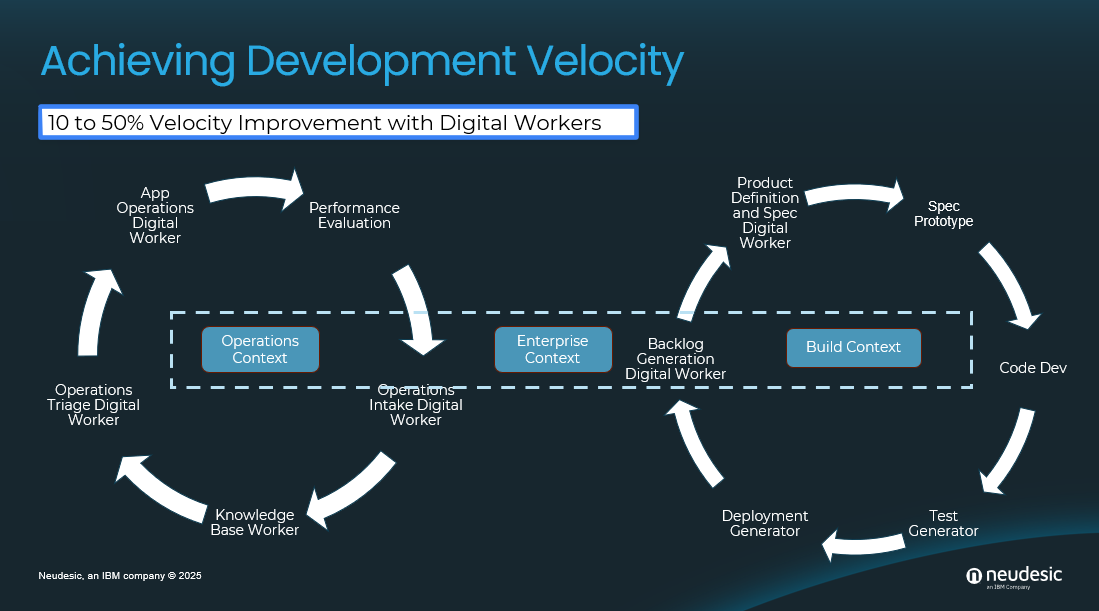
Each of these digital workers operates with enterprise-specific knowledge. They are configured with an understanding of the organization’s tech stack, standards, and objectives. For example, the Deployment Worker will know whether the company uses Azure or AWS and produce appropriate deployment code. The Backlog Worker might integrate with the company’s OKR system or incident logs to prioritize work. This enterprise context ensures that AI agents aren’t coding in a vacuum – they follow the same rules and use the same data a human teammate would.
Managing a “digital workforce” introduces challenges akin to managing human teams. There must be oversight, coordination, and governance. Companies like Microsoft and others have started building platforms for Digital Workforce Management – essentially a “HR system” for AI agents. These platforms handle versioning of AI models, permissions (which data an AI can access), performance monitoring, and orchestrating hand-offs between agents and human owners. The goal is to ensure accountability and safety even as we give AI more autonomy. As one executive put it, enterprises don’t need just another AI demo – they need a managed digital workforce with clear roles, accountability, and guardrails. With proper controls, organizations can confidently let these agents collaborate on real projects.
The Power of Application & Enterprise Context
A key factor behind the success of spec-driven development and digital workers is the rich context we can now provide to AI. Early coding AIs had very limited memory of the project – they might autocomplete a few lines based only on the current file. Today’s AI agents, by contrast, can absorb entire codebases and document repositories into their context window. This opens up a world of possibilities: the AI doesn’t have to guess what an API does or what the business domain is – it can be informed by actual knowledge from across the enterprise.
Consider the Operations context: modern software produces logs, metrics, and traces. An AI Ops agent can ingest a live log stream and recognize, for example, that a new deployment caused a 30% latency spike in a certain service. Instead of waiting for a human to notice and open a ticket, the agent itself flags this and might even pinpoint the likely cause (say, a specific database query introduced in the latest release). Feeding this information to a Backlog Generation Worker means the next sprint could automatically include a task like: “Investigate and optimize the slow database query in OrderService – introduced in release X, causing 30% latency increase.” The developer who picks it up has concrete data and perhaps even an AI-suggested fix, instead of a vague bug report. This tight coupling of ops data to dev tasks is the DevOps ideal – and now much of the heavy lifting is done by AI in seconds.
On the Enterprise context side, think of all the knowledge that lives outside the code: architecture diagrams, security guidelines, customer feedback, regulatory requirements, support FAQs, and so on. Previously, making sure a developer considered all this context relied on memory or process; now we can systematically include it. For instance, before writing code, an AI Product Spec Worker could pull in relevant Confluence pages, past design docs, or even contract terms to ensure the spec covers all bases. Some organizations build internal tools to aggregate this knowledge for AI consumption. For example, they might create a knowledge graph linking legacy code with JIRA tickets and wiki pages – giving the AI a 360° view of both the code and the context of its use. This practice is sometimes called “context engineering”: curating the perfect set of facts for the AI to have on hand, so its outputs are accurate and aligned with business reality.
Advanced AI models like Anthropic’s Claude and the latest GPT-based systems are designed for deep context integration. Claude’s huge context window (about 100,000 tokens) means it can literally read hundreds of pages of documentation or code in one go. In a complex enterprise scenario, one could feed in an entire API spec, recent incident post-mortems, and relevant compliance rules – and the AI can synthesize a solution that respects all those constraints. (Anthropic even demonstrated Claude editing a full novel in under a minute; in business terms, that’s like scanning all HR policy documents to apply a new rule change instantly.) In short, the AI can now act with the wisdom of a domain expert because it has the domain’s knowledge at its fingertips.
Combining AI-driven development with rich enterprise context leads to higher-quality, more compliant code delivered faster. For example, an internal team at Azure reported that they used an AI-augmented workflow to add a cross-platform feature initially estimated at two weeks of work – but by analyzing the entire codebase and related documents for context, the AI delivered a solution in just two days. Even if not every task sees such a dramatic 5× speedup, improvements of 2× or more are being noted, which is transformative at scale. Many companies find that by combining tools, historical knowledge, and AI reasoning, what once took a team a month can be done by an AI-assisted team in a week or less.
Context also improves safety and governance. AI agents operating on production systems must not go rogue or violate policies. By instilling corporate rules (like coding standards, data privacy guidelines, and regulatory requirements) into an agent’s knowledge base or prompts, we ensure those policies are automatically followed. For example, an enterprise can maintain an internal “Secure Coding Guidelines” document; any code generation AI can reference that to avoid known insecure functions or patterns. This reduces the burden on later code reviews and security audits. It’s like having an expert who never forgets a rule, constantly checking the AI’s work.
Measured Impact: Velocity, Quality, and Modernization
Adopting spec-driven development with digital workers is yielding notable benefits in practice. The headline is developer velocity – faster delivery of features and fixes. For example, GitHub’s internal research at a Fortune 500 company showed that with AI coding assistants, developers created 8.8% more pull requests and saw an 84% increase in successful build rates (fewer broken builds) compared to teams without AI help. This aligns with the common finding that Copilot can make developers roughly 50% faster on certain coding tasks. Now, those gains mostly concern the coding phase. The real opportunity is to extend improvements across all phases of development: requirements, coding, testing, and operations. Early adopters of multi-agent workflows report overall 10–50% faster cycle times for delivering new capabilities by using AI throughout – from initial requirement gathering with a chat-style agent, to instant spec drafting, to rapid coding and testing, all the way through automated deployment.
Critically, velocity gains are being achieved without sacrificing (and often while improving) quality and maintainability. By enforcing clearer definitions of “done” and automating test creation, teams have seen better quality metrics. In the GitHub example, not only did output increase, but the AI-assisted group’s code had higher merge success rates and more tests passed in CI. Because spec-first development makes teams explicitly consider edge cases and acceptance criteria, the software tends to have fewer gaps in functionality or hidden assumptions. The AI implements exactly what’s in the spec; if the spec is thorough, the solution tends to cover all the necessary scenarios.
For large-scale modernization projects, these approaches can be game-changing. Modernization often involves translating millions of lines of legacy code to modern platforms – a massive manual effort. Digital workers can handle the bulk of this grunt work. For instance, a Legacy Code Conversion Worker might translate an entire module of COBOL into Java, or convert a suite of on-premise ETL jobs into cloud data pipelines, in hours rather than weeks. In practice, teams are finding the AI can handle perhaps 80% of the code conversion tasks, leaving humans to focus on the tricky 20% (such as edge cases or major design upgrades). This not only accelerates the project timeline, it often results in a cleaner end-state because the AI can apply consistent patterns and even suggest refactorings during translation.
Beyond code, digital workers help with the surrounding drudgery of modernization – like updating documentation and migrating data. An AI documentation bot can read an old system’s manuals and auto-generate new documentation or inline comments in the code. Another agent might analyze database schemas and produce a mapping or ETL script for the new system’s database. By turning what used to be months of peripheral tasks into an automated background process, teams can achieve faster, smoother migrations with fewer post-migration issues.
These improvements aren’t just theoretical. One large bank that embraced AI-assisted development reported delivering a revamped core application in half the expected time. Industry analysis also shows that organizations in the top quartile of developer velocity (often bolstered by automation and AI) grow revenue four to five times faster than those in the bottom quartile. In short, spec-driven development and digital workers aren’t just cool ideas – they’re producing tangible gains in how quickly and reliably companies can evolve their software.
Best Practices for Implementing AI-Driven Development
Transitioning to spec-driven development with digital workers requires changes in team culture and processes. Here are some practical strategies from early adopters:
· Start with a Pilot Project: Don’t overhaul everything at once. Pick a self-contained module or feature to try out spec-first, AI-assisted development. For example, in one sprint, take a medium-complexity user story and follow the SDD approach end-to-end: write a detailed spec, use an AI tool to generate an initial design and code, then iterate with the team’s feedback. A small pilot lets you learn what works and what might need tweaking, without putting a mission-critical project at risk.
· Invest in Writing Good Specs: Team members may need to develop the skill of writing specs that are clear enough for an AI to follow. A good spec is unambiguous, concise, and test-oriented. It should include not just the happy path but also edge cases, constraints, and acceptance criteria (potentially using a format like Given/When/Then for clarity). It helps to have templates or examples of well-written specs as a reference. Some organizations even designate an “AI facilitator” or prompt engineer initially – someone who excels at translating requirements into effective prompts/specs for the AI – to guide others until it becomes second nature.
· Use a “Plan First, Then Code” Approach: Rather than asking an AI to write code from a requirement in one go, first ask it to generate a plan or outline. For instance, have the AI produce pseudocode, a list of steps, or an architectural sketch for the solution. Review that plan to ensure the AI understood the spec correctly. Only then let the AI turn the plan into actual code. This two-step approach catches misunderstandings early and drastically reduces wasted effort, keeping the AI’s work on track. Many teams have found that an AI-generated outline followed by human feedback yields much better final code.
· Chain Your AI Agents: Combine multiple digital workers to handle different stages of the development pipeline automatically. For example: an Ops Triage agent identifies an issue and creates a ticket; a Spec Generation agent drafts a spec for the fix; a Code Gen agent writes the code change; a Test agent creates and runs regression tests; and a Deployment agent pushes the fix to a staging environment. You can use scripts or workflow tools so that one agent’s output triggers the next agent in line. In the beginning, you might only automate a couple of hand-offs and rely on humans for integration, but over time you can build a more seamless AI-driven pipeline (with human approvals at key control points). Think of it like setting up a continuous integration/continuous delivery (CI/CD) pipeline, but one that includes AI in each step.
· Keep Humans in the Loop: Even if AI agents can operate autonomously, human oversight is crucial. Treat AI-generated artifacts as drafts. Always have developers review AI-written code and designs – both to catch mistakes and to infuse human insight. Run the tests (especially if an AI generated them) to validate that the code meets the spec and doesn’t break anything unexpected. For critical actions (like deploying to production or modifying sensitive data), require a human sign-off. Over time, as you gain confidence in certain agents (e.g., you might find the test-generation agent is consistently reliable), you can streamline the process and reduce manual checks. But especially early on, trust but verify is the mantra.
· Continuously Update the AI’s Knowledge: Make sure to feed your AI agents the latest information about your systems and guidelines. If you adopt a new architecture pattern or update a library, ensure this is reflected in the data or documents the AI has access to. Set up a routine (for example, at the end of each sprint) to refresh the knowledge base that your digital workers use, adding new design docs, recent decisions, and any newly discovered pitfalls. Likewise, manage the scope of context for each task – give the AI enough information to be effective, but not so much that it gets overwhelmed or picks up irrelevant details. In addition, maintain strict data governance: if using external AI services, utilize enterprise plans that keep your code and data private.
· Measure & Iterate: Finally, track how these changes are affecting your team’s performance and adjust accordingly. Measure key indicators like lead time (how fast from idea to deployment), defect rates, incident frequency, and team satisfaction. Compare them to baseline metrics from before the AI-driven approach. Celebrate improvements to build momentum. For any areas that don’t improve or get worse, do a retrospective to understand why – maybe the specs need to be more complete, or perhaps the AI model needs fine-tuning on your codebase. Use these lessons to refine your process, train your team further, or tweak the AI tools’ configuration. Embracing spec-driven development with AI is an iterative journey; it’s important to learn and adapt as you go.
By following these practices, teams can gradually evolve into a human+AI co-development workflow that feels natural and efficient. The goal is for developers to spend more time on creative problem-solving, system architecture, and fine-tuning, while the digital workers handle repetitive tasks, enforce best practices, and generate initial drafts of solutions for human review.
A New Development Paradigm
Spec-driven development and AI-powered digital workers represent a significant shift in how software is built – arguably the biggest shift since the adoption of Agile and DevOps. In this new paradigm, developers are not just code writers but architects and orchestrators, defining what needs to be done and guiding AI agents on how to do it.
What makes Spec-Driven Development different from traditional approaches is the elevation of the specification to a first-class artifact. Instead of code being the primary source of truth, the spec is. This encourages thinking through problems deeply and clearly before implementation, which leads to more robust designs and less wasted effort. When combined with AI that can execute these specs, it creates a powerful feedback loop: better specs lead to better code, delivered faster.
Integrating enterprise context ensures that the AI doesn’t operate in isolation. By providing the AI with knowledge of your specific business domain, tech stack, and past projects, you get outputs that are more relevant and trustworthy. The AI becomes an extension of your team’s collective memory and expertise, rather than just a generic code generator. This context-driven approach is a key reason companies are seeing 10–50% improvements in delivery times – the AI isn’t reinventing the wheel or making naive mistakes, because it “knows” the environment it’s working in.
Meanwhile, Digital Workers act as force multipliers throughout the development process. They allow a small team to punch above its weight by effectively adding dozens of specialized helpers that work tirelessly. Instead of replacing developers, these AI agents free developers from grunt work and help ensure that nothing falls through the cracks (be it a forgotten requirement, a missed test, or an undocumented deployment step). The developers, in turn, move into more strategic and oversight roles – focusing on creative design, complex debugging, and mentorship – with AI handling the boilerplate and routine.
This new way of building software is both comprehensive in vision and grounded in real results. It’s comprehensive because it touches every phase of development, potentially reinventing how we do planning, coding, and operations. It’s visionary because it paints a future where we routinely achieve productivity and quality levels that were previously out of reach. And yet it’s practical: the tools (like GitHub Copilot, Claude, and custom AI agents) and techniques (writing good specs, automating pipelines) are available today, and early adopters are already seeing success.
The takeaway is that Spec-Driven Development is not just a buzzword or a theoretical ideal, but a pragmatic approach to making AI a reliable partner in software creation. When you clearly define what you need (the spec), and give an AI the context it needs to understand your world, you can delegate a surprising amount of work to machines. The end result is software built faster and with fewer bugs, while developers focus on what they do best. In a world where every company is becoming a software company, embracing this paradigm shift could very well determine who leads and who lags in the coming years.
#RunWithNathan
 Nathan Lasnoski