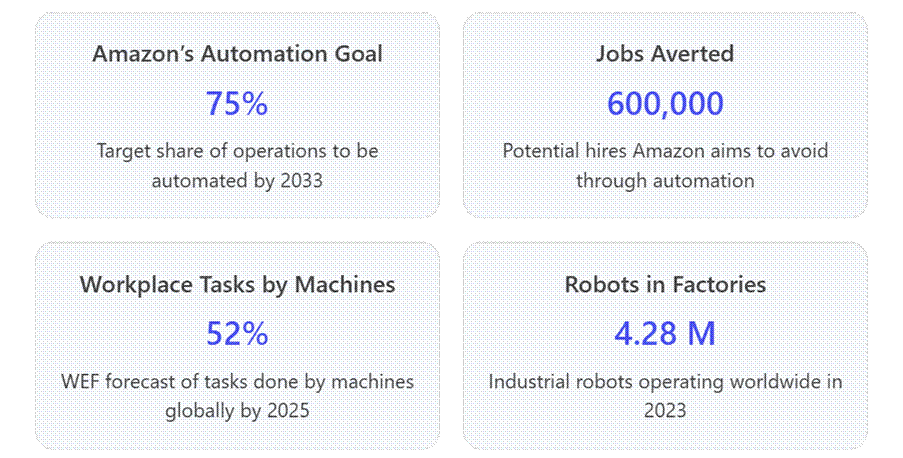
Automation and AI have entered a new era – one in which “digital workers” (robots, AI agents, software bots) might soon handle half or more of all work tasks across many businesses. This isn’t science fiction or distant speculation; it’s happening now. A leaked Amazon robotics plan recently revealed ambitions to automate up to 75% of Amazon’s operations over the next decade, potentially eliminating the need to hire 600,000 human workers in U.S. warehouses by 2033 [1] [2]. And Amazon is not alone. Across logistics, manufacturing, healthcare, finance and beyond, organizations are deploying digital workers at scale – from warehouse robots to AI assistants – fundamentally changing how work gets done.
The Rise of Digital Workers in the Org Chart
Traditionally, an organizational chart maps out human roles – executives, managers, staff – in a hierarchy. Today, however, many companies must also chart their digital workforce: the AI systems and robots executing tasks alongside people. In fact, forward-looking business leaders are beginning to ask, “What percentage of my business will be made up of digital workers, and what tasks will those digital workers perform?” [3]. Some predict that future org charts will have mirror organizations of human employees and AI agents working in tandem [4].
Digital workers can be physical robots on a factory floor or software-based agents in an office workflow. They don’t get a salary or office cubicle, but they contribute to output just like a human employee – often at far greater speed and scale. A recent internal index from Microsoft describes a shift toward “human organizations and complementary agent organizations” that together produce more output with greater efficiency [5]. In other words, companies are structuring themselves to combine human strengths (creative thinking, relationship-building, oversight) with machine strengths (speed, precision, 24/7 endurance).
We are entering an era on par with the Industrial Revolution [6], where the very nature of work and organization is transforming. Just as steam power and mechanization redefined 19th-century businesses, AI and robotics are redefining today’s enterprises. The endgame is not necessarily to have fewer human workers, but to amplify what the organization can achieve by delegating work to machines in a way never done before [7].
Digital Workers Across Industries: From Warehouses to Hospitals
Virtually every industry is seeing a surge in digital worker deployment. Below we explore a few sectors leading this shift and how “virtual” or “robotic” employees are becoming integral team members:
Logistics & Retail: Automated Muscle and Minds
Case in point: Amazon. In Amazon’s massive fulfillment centers, fleets of robots glide across the floors ferrying goods, and sophisticated robotic arms (with names like Proteus and Sequoia) handle picking and sorting of packages [8]. According to leaked documents, Amazon’s Robotics division plans to automate ~75% of warehouse and logistics operations, which could replace or avoid over 600,000 human jobs by 2027 [9]. Already, the company operates with over 1,000,000 robots worldwide in its facilities [10]. Its newest high-tech warehouse in Louisiana uses about 1,000 robots and needs 25% fewer human workers than a traditional site [11]. These robots – essentially Amazon’s digital workers – toil around the clock, moving, lifting, sorting products without breaks [12].
Other retailers and delivery companies are following suit. Walmart, Target, FedEx and others are experimenting with similar automation to stay competitive [13]. Autonomous guided vehicles in warehouses, AI-driven inventory systems, and even delivery drones and self-driving trucks are on the rise. Amazon itself is exploring driverless delivery vans and drone drop-offs, which could eventually disrupt tens of thousands of delivery driver jobs [14]. In the org chart of a logistics firm, one might now find entire “teams” of bots – for example, a picking robot crew supervised by a human manager – responsible for the same outcomes that human pickers and loaders handled in the past.
Human roles in logistics are shifting accordingly. Rather than performing repetitive picking or physical lifting, many humans now oversee the automated systems, troubleshoot exceptions, and handle tasks requiring judgement. One Amazon spokesperson insisted that robots “work alongside humans, not replace them,” freeing people from repetitive strain [15] [16]. In a highly automated warehouse, a handful of technicians monitor conveyor belts and robot fleets, intervening only when something goes awry or a decision beyond the machines’ scope is needed. “The humans exist to validate the process is running properly and remediate it when it is broken, as well as one special thing… ambiguity,” observes one industry expert [17]. In other words, people deal with the unexpected – a task no AI is fully reliable at (yet).
Manufacturing: From Assembly Lines to “Lights-Out” Factories
Manufacturing was among the first sectors to embrace automation. Industrial robots have been welding, painting, and assembling products in factories for decades. But we’ve now reached a point where some factories operate 24/7 in the dark, with no human on-site – the so-called “lights-out” manufacturing. For instance, FANUC, a Japanese robotics company, has run a factory since 2001 where robots build other robots; the facility can run unsupervised for up to 30 days, producing 50 robots per day without human intervention. Globally, industry has installed a record number of robots: over 4.28 million industrial robots were in operation in factories worldwide in 2023, a number that continues to grow rapidly each year.
In automotive plants, it’s routine now to see robotic arms outnumbering humans on the assembly line. These automated workers handle dangerous or tedious tasks like heavy lifting and precision welding. In electronics manufacturing, high-speed robotic assemblers and AI-powered optical inspection systems churn out circuit boards far faster (and often with fewer errors) than any human hand. Quality control roles are also being taken up by machine vision systems that detect defects that human eyes might miss.
However, as machines take on the manual and repetitive labor, the role of human workers shifts to roles like robotic maintenance, programming, and system oversight [18]. For example, a traditional assembly line worker might transition into a robotics technician who keeps the machines running or a manufacturing data analyst who uses AI-driven dashboards to optimize production. These emerging roles require more technical skills and problem-solving abilities, illustrating how ingenuity and adaptability are now valued factory-floor skills.
Healthcare: AI Caregivers and Robotic Assistants
Healthcare might seem fundamentally human-centric – and indeed, empathy and human connection remain irreplaceable – but even here digital workers are increasingly present. Hospitals have begun using autonomous service robots to handle routine physical tasks. In the U.S., for example, some hospitals employ robots as couriers: self-driving hospital robots deliver meals and medications to patient rooms, navigating hallways and even riding elevators on their own [19]. By offloading these delivery duties, hospitals free up nurses and support staff to spend more time caring for patients.
Another “digital worker” in healthcare is AI-driven diagnostic systems. In medical imaging, AI algorithms now assist radiologists by scanning X-rays, MRIs, and CT scans for abnormalities. In Ghana, a startup’s AI tool can accurately diagnose conditions like an enlarged heart (cardiomegaly) from chest X-rays more accurately than many specialists, helping compensate for a shortage of radiologists [20]. Rather than replace the doctor, this AI acts as a tireless assistant, reviewing images quickly so the human expert can focus on confirming results and planning treatment. Similarly, machine learning models analyze pathology slides to flag suspicious areas for oncologists.
Healthcare also benefits from robotic process automation (RPA) behind the scenes. Administrative tasks – insurance claims processing, medical record updates, appointment scheduling – are being automated by software bots. This reduces paperwork burdens on human staff. In fact, Gartner analysts predict half of U.S. healthcare providers will invest in RPA within three years, aiming to cut costs and administrative delays.
The net effect in healthcare is that human roles are refocusing on what humans do best: caregiving, complex decision-making, and innovative research. Doctors and nurses can devote more attention to direct patient interaction when automation handles the “busy work.” A World Economic Forum report notes that intelligent automation is already reducing admin loads and giving healthcare workers “more time for their patients” [21]. But to fully realize this, hospitals and health systems must integrate these tools carefully, ensuring they truly improve staff experiences and patient outcomes [22] [23].
Finance & Office Work: From Number-Crunching Clerks to AI Analysts
In offices and banks, digital labor often takes the form of algorithms and software robots rather than physical machines. Financial services companies have widely adopted RPA and AI to automate routine tasks like data entry, transaction processing, and report generation. By one McKinsey estimate, about 42% of finance activities could be automated with current technology [24]. No surprise then that 72% of CFOs say they’ve implemented RPA in some form in their finance departments as of 2021 [25].
Common digital workers in finance include bots that handle accounts payable and receivable (scanning invoices, matching purchase orders, posting payments), automated report generators that compile monthly financial statements, and AI-powered fraud detection systems monitoring transactions. At JPMorgan, an in-house AI called COIN was reported to handle contract review processes in seconds that once took legal officers 360,000 hours of work – a dramatic example of an AI worker handling mind-numbing document processing at lightning speed. Meanwhile, customer-facing bots are also on the rise: many banks and insurance firms use chatbot “agents” to field basic customer service queries or help users fill out forms, reducing calls to human agents.
As these digital workers proliferate, traditional roles are evolving rather than vanishing overnight. Take bookkeeping and accounting: repetitive data reconciliation and entry-level accounting jobs are declining, but demand is rising for financial analysts and advisors who can interpret data and provide strategic guidance – work that requires business acumen and human judgment. The World Economic Forum projected that roles like data analysts, software developers, and customer service specialists (leveraging human skills plus tech) will grow, while purely routine clerical roles (data entry clerks, accounting clerks) will diminish [26]. We’re already seeing that: a lot of back-office “paper-pusher” jobs are being supplanted by software, while new jobs in fintech, data science, and compliance (ensuring the algorithms behave ethically and legally) are being created.
Crucially, tasks involving trust, empathy, and creativity are still handled by humans in finance. For example, financial advisors who build personal relationships with clients, or creative strategists who design new financial products, are leveraging what machines can’t replicate – emotional intelligence and original thinking. In fact, even as AI crunches numbers in the background, the value of soft skills rises: communication, critical thinking, and creative problem-solving have become even more important for finance professionals [27] [28]. Companies will need people who can work with the AI tools, interpret their outputs, and ensure they’re used responsibly.
Traditional vs. Digital Roles: A Cross-Industry Snapshot
To better illustrate how work is changing, here’s a quick look at some traditional human roles and their emerging digital worker counterparts across different industries:
| Industry | Traditional Human Role | Emerging Digital Worker Role |
| Logistics | Warehouse Picker / Forklift Operator | Mobile Warehouse Robot (autonomously picks & moves goods)1; Self-driving Forklift |
| Retail | Store Inventory Clerk | AI Vision System for Inventory (automatic shelf scanning & stock alerts) |
| Manufacturing | Assembly Line Worker (e.g. welder, assembler) | Industrial Robotic Arm (24/7 welding, assembly); “Lights-out” Robot Factory |
| Quality Control | Human Inspector (product QA) | Machine Vision QA System (AI-powered defect detection) |
| Healthcare | Hospital Courier/Orderly | Autonomous Delivery Robot (meds & meals in hospitals)3 |
| Healthcare | Radiologist (image analysis) | Diagnostic AI (scans X-rays/MRIs for anomalies)3 |
| Finance | Data Entry Clerk / Bookkeeper | RPA Bot for Data Entry (e.g. invoice processing)4 |
| Finance | Customer Service Rep (call center) | AI Chatbot / Virtual Agent (front-line customer queries) |
| Banking | Teller / Branch Banker | ATM and Online Banking Bots (cash handling, basic transactions) |
| Administration | Secretary / Mailroom Staff | Automated Workflow Bot (scheduling, routing documents, email sorting) |
(Sources: Amazon automation report [29] [30]; IFR robotics data; WEF/NYTimes on healthcare robots [31] [32]; Deloitte on RPA in finance [33] [34]; WEF Future of Jobs report [35].)
This table highlights a pattern: mundane, routine tasks are increasingly done by machines, while humans concentrate on tasks that require flexibility, problem-solving, creativity, or interpersonal skills. For every job where a human’s primary duty was repetitive (whether hauling goods or typing data into forms), there is now a digital worker eager to take over that repetition. And for every digital worker, we see the need for humans to do complementary work – whether it’s exceptions handling, maintenance, or higher-level thinking.
Lessons from the First Industrial Revolution: Benefits and Pitfalls
History offers a guide for navigating this workforce transformation. The Industrial Revolution (18th–19th centuries) was the last time we saw such a dramatic shift in work. Back then, mechanization and factory systems brought immense productivity gains and societal changes. We can draw parallels and also learn from the mistakes of that era to avoid repeating them.
What We Learned from History:
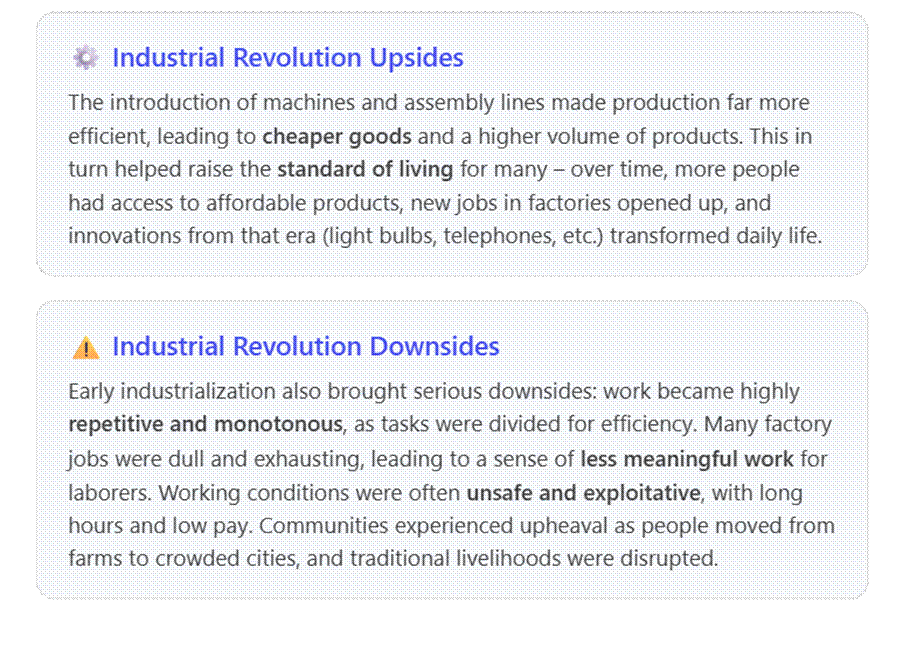
Indeed, as factories spread in the 1800s, observers like Charles Dickens wrote about the dehumanizing aspects of repetitive factory work and the dark “satanic mills” of industrial towns. Workers themselves felt the work lacked the independence and craft of earlier agrarian or artisan jobs. Monotony and fatigue were constant adversaries for the working class back then. It took decades for labor rights, safety regulations, and job diversification to catch up and improve the lot of workers.
On the positive side, the Industrial Revolution undeniably boosted productivity and wealth. Goods that once were luxury (like cloth, tools, later even cars) became mass-produced and accessible. Overall life expectancy and income eventually rose as economies grew. So there’s a trade-off: technology made life better in aggregate, but individual workers often paid a price, especially in the transition period.
Avoiding Déjà Vu: How to Mitigate the Negative Effects This Time
As we usher in the era of AI and digital workers – often dubbed the “Fourth Industrial Revolution” – we have the opportunity (and responsibility) to avoid the darker outcomes of the past. Here are some ways businesses and society can maximize the benefits of automation while minimizing harm:
- Invest in Reskilling and Upskilling: One clear lesson is the need to help workers adapt. The World Economic Forum emphasizes that companies should “take an active role in supporting their existing workforces through reskilling and upskilling” to meet the new skill demands [36] [37]. Workers who once performed manual or routine tasks can be trained to manage, program, or collaborate with the new technologies. For example, an assembly line operator might be trained in basic robot maintenance or data interpretation. Lifelong learning becomes essential; today’s employees may go through multiple rounds of skill upgrades as automation evolves [38]. The benefit is twofold: job security for employees and a skilled talent pool for employers. It’s encouraging that in some cases, companies are reinvesting savings from automation into creating new roles – Amazon, for instance, has pointed to new positions like robotics maintenance techs and AI system managers as growth areas that come with its automation push [39].
- Focus on Human-Centric Roles: We must consciously design organizations such that humans gravitate toward roles that play to human strengths – creativity, empathy, complex decision-making. As machines do more of the routine work, companies can redefine job descriptions to emphasize the parts of the work that require a human touch. We’re already seeing increased demand for jobs in areas like customer experience, creative strategy, innovation, and people management [40] – roles where emotional intelligence and imagination are key. By recognizing that “jobs requiring human skills” (like sales, marketing, customer service) will grow [41], businesses can channel workers into those roles rather than let them go. In short, let AI handle the drudgery, and free humans to do what only humans can do – building relationships, dreaming up new ideas, and solving tricky interdisciplinary problems.
- Augmentation, Not Pure Automation: A successful model is one of “human-AI collaboration” rather than total replacement. Think of digital workers as assistants or teammates. They might take over 50% of tasks, but the remaining 50% (often the more complex half) is handled by humans with the AI’s support. For instance, in healthcare, AI can draft a patient chart, but a doctor reviews and finalizes it – saving time but keeping a human in the loop to ensure accuracy and empathy. Many companies talk about “copilots” or “co-bots” (collaborative robots) rather than independent robots [42]. This framing encourages a workflow where automated systems handle the heavy lifting, then hand off to humans for fine-tuning or final decision-making. Such synergy can also make jobs more meaningful – the tedious part is done by the bot, and the human gets to focus on higher-value aspects. As an example, an AI might sift through thousands of support tickets and only escalate the truly tricky ones to a human customer support rep, who can then spend time solving real customer challenges with care. One internal expert noted that digital workers are there to “help you with those tasks that you always want to do but never get to… \[and] speed up your workflow”, rather than simply replace people [43]. Embracing that mindset is crucial.
- Provide Safety Nets and Transition Support: No matter how much we emphasize reskilling, some displacement is inevitable. Not every worker can be immediately retrained for a highly skilled role, and not every region will have booming job alternatives ready. This is why economists and futurists urge policy measures and corporate responsibility to cushion the transition. During the Industrial Revolution, lack of safety nets led to severe hardship for many. Today, governments and companies can collaborate to provide temporary support, job transition programs, or even guaranteed basic incomes in areas heavily affected by automation. In its Future of Jobs report, the WEF advised governments to prepare social safety nets for workers and communities threatened by the coming shifts [44]. This could include unemployment benefits, public retraining programs, and incentives for industries that create local jobs. From a corporate perspective, transparency and gradual implementation can help – for instance, not laying off workers outright but retraining or reallocating them over time as digital workers come onboard, or offering generous severance and career counseling when redundancies occur. If we proactively address these issues, we can avoid the worst-case scenario of whole communities being economically devastated (a real risk if, say, an Amazon warehouse town suddenly doesn’t need its 1,000 workers because robots took over [45]).
- Redefine Metrics of Success: As we integrate digital workers, companies should broaden how they measure workforce productivity and well-being. It’s not just about output per dollar – worker satisfaction and societal impact matter too. One could argue that a lesson from the 1800s is that treating people as cogs backfires (it led to unrest, strikes, etc.). This time, companies can strive for a “win-win”: use AI to boost efficiency and make human jobs better. That might mean redesigning workflows so that humans do more creative and less menial work (leading to higher job satisfaction) and sharing the gains of automation through better wages or reduced work hours. Some futurists even envision that as digital workers do 50% of tasks, humans might enjoy shorter workweeks or devote more time to creative pursuits – essentially increasing quality of life, not unlike how productivity gains eventually reduced the average workweek over the 20th century. Organizations should also think about governance for digital workers: for example, ensuring AI decisions are fair and transparent, much as we ensure human workers follow ethics and laws. Establishing guidelines for how AI is deployed (and when a human must be in control) will be important for building trust among employees and customers.
Embracing the Future: Humans + Digital Workers Driving Progress
To circle back to the present: companies are already restructuring to incorporate digital workers, and many more will follow. The org chart of 2030 might have departments of algorithms and fleets of robots listed right alongside teams of people. It’s conceivable that a future Chief Productivity Officer oversees both human resources and AI resources. We might talk about the performance of our AI team members just as we discuss human employee performance (albeit measured in different terms). A recent Microsoft Work Trends Index even imagines complementary “agent organizations” operating in parallel with human organizations within a business [46].
Such an integrated workforce holds incredible promise. If digital workers take on 50% (or more) of the workload, businesses could achieve leaps in efficiency, scale, and innovation. Imagine construction projects where robot crews do the heavy labor while humans focus on engineering and design improvements; or legal firms where AI paralegals digest case law overnight, and attorneys craft arguments by day. The capacity of an organization could far exceed what was previously possible, potentially boosting economic growth and freeing humans from many forms of drudgery.
But success isn’t guaranteed. How we manage this transition will determine whether automation’s bounty is broadly shared or narrowly concentrated, and whether work in the future is fulfilling or dystopian. The hopeful vision is one where digital workers handle the boring and dangerous, while human workers engage in creative, meaningful endeavors – and together they propel organizations to new heights. The more concerning vision is one of mass displacement and a widening skills gap.
Avoiding that outcome requires leadership and foresight today. Businesses should start including digital workers in their strategic planning and training programs now. Education systems must adapt to equip the next generation with the skills to collaborate with AI. And each of us, as professionals, can benefit from learning how to leverage AI tools in our field – essentially learning to manage our digital “coworkers.”
In conclusion, the move to digital workers is not just a tech upgrade; it’s a fundamental shift in how we think about work and organization. It calls for a new kind of org chart – one that recognizes non-human contributors as part of the team. Companies that get this right will likely outperform those that don’t, as they’ll harness the best of both artificial and human intelligence. And society at large stands to gain: higher productivity and innovation, alongside hopefully more human-centric jobs and improved quality of life. We’ve navigated such shifts before (the Industrial Revolution) with mixed results. This time, armed with historical insight and modern values, we can strive to ensure that the rise of digital workers benefits everyone – by design, not by accident.
Nathan
[1]Machines will do more tasks than humans by 2025: WEF – ARY News
[2]Machines will do more tasks than humans by 2025: WEF – ARY News
[3]What percentage of your future org is Digital Workers?
[4]What percentage of your future org is Digital Workers?
[5]What percentage of your future org is Digital Workers?
[6]What percentage of your future org is Digital Workers?
[7]What percentage of your future org is Digital Workers?
[8]Machines will do more tasks than humans by 2025: WEF – ARY News
[9]Machines will do more tasks than humans by 2025: WEF – ARY News
[10]Machines will do more tasks than humans by 2025: WEF – ARY News
[11]Machines will do more tasks than humans by 2025: WEF – ARY News
[12]Machines will do more tasks than humans by 2025: WEF – ARY News
[13]Machines will do more tasks than humans by 2025: WEF – ARY News
[14]Machines will do more tasks than humans by 2025: WEF – ARY News
[15]Machines will do more tasks than humans by 2025: WEF – ARY News
[16]Machines will do more tasks than humans by 2025: WEF – ARY News
[17]What percentage of your future org is Digital Workers?
[18]Machines will do more tasks than humans by 2025: WEF – ARY News
[19]How automation gives healthcare workers time for patients
[20]How automation gives healthcare workers time for patients
[21]How automation gives healthcare workers time for patients
[22]How automation gives healthcare workers time for patients
[23]How automation gives healthcare workers time for patients
[24]Top 9 RPA Use Cases & Examples in Finance in 2025
[25]Top 9 RPA Use Cases & Examples in Finance in 2025
[26]Machines will do more tasks than humans by 2025: WEF – ARY News
[27]Machines will do more tasks than humans by 2025: WEF – ARY News
[28]Machines will do more tasks than humans by 2025: WEF – ARY News
[29]Machines will do more tasks than humans by 2025: WEF – ARY News
[30]Machines will do more tasks than humans by 2025: WEF – ARY News
[31]How automation gives healthcare workers time for patients
[32]How automation gives healthcare workers time for patients
[33]Top 9 RPA Use Cases & Examples in Finance in 2025
[34]Top 9 RPA Use Cases & Examples in Finance in 2025
[35]Machines will do more tasks than humans by 2025: WEF – ARY News
[36]Machines Will Do More Tasks Than Humans by 2025 but Robot Revolution …
[37]Machines Will Do More Tasks Than Humans by 2025 but Robot Revolution …
[38]Machines will do more tasks than humans by 2025: WEF – ARY News
[39]Machines will do more tasks than humans by 2025: WEF – ARY News
[40]Machines will do more tasks than humans by 2025: WEF – ARY News
[41]Machines will do more tasks than humans by 2025: WEF – ARY News
[42]Machines will do more tasks than humans by 2025: WEF – ARY News
[43]Sync with Neudesic – Digital Workers -20250904_110132-Meeting Recording
[44]Machines will do more tasks than humans by 2025: WEF – ARY News
[45]Machines will do more tasks than humans by 2025: WEF – ARY News
 Nathan Lasnoski